Advertisements
Advertisements
प्रश्न
Consider the following cyclic process consist of isotherm, isochoric and isobar which is given in the figure.

Draw the same cyclic process qualitatively in the V-T diagram where T is taken along the x-direction and V is taken along the y-direction. Analyze the nature of heat exchange in each process.
Advertisements
उत्तर
Process 1 to 2: increase in volume. So heat must be added.
Process 2 to 3: Volume remains constant. Increase in temperature. The given heat is used to increase the internal energy.
Process 3 to 1: Pressure remains constant. Volume and Temperature are reduced. Heat flows out of the system. It is an isobaric compression where the work is done on the system.

Explanation: In the graph, during the process (1 to 2), the gas undergoes isothermal expansion. It receives a certain amount of heat from its surroundings. It uses this heat in doing the work. Hence internal energy of the gas remains unchanged.
During the process represented by (2 to 3), the gas is heated at a constant volume. Since no work is done and volume does not change, the process is an isochoric process.
Since heat is transferred to the gas from the surroundings, the internal energy of the gas is increased. During the process represented by (3 to 1), the gas is compressed isobarically. Work is done on the gas. Since temperature drops internal energy is reached. Hence the gas gives up heat to the surroundings.
APPEARS IN
संबंधित प्रश्न
A thermodynamic system is taken from an original state to an intermediate state by the linear process shown in Figure
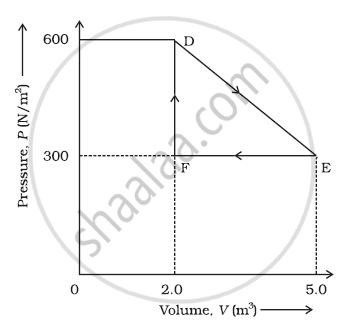
Its volume is then reduced to the original value from E to F by an isobaric process. Calculate the total work done by the gas from D to E to F
An ideal gas is taken through an isothermal process. If it does 2000 J of work on its environment, how much heat is added to it?
What is a thermodynamic process?
Explain graphically (i) positive work with varying pressure, (ii) negative work with varying pressure, and (iii) positive work at constant pressure.
When food is cooked in a vessel by keeping the lid closed, after some time the steam pushes the lid outward. By considering the steam as a thermodynamic system, then in the cooking process
Apply first law for an adiabatic process.
Draw the PV diagram for the adiabatic process.
Derive the work done in an adiabatic process.
For an isothermal expansion of a perfect gas, the value of `(Delta "P")/"P"` is equal to ____________.
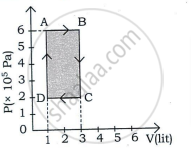
An ideal gas is taken through a cyclic process ABCDA as shown in figure. The net work done by the gas during the cycle is ______.