Advertisements
Advertisements
प्रश्न
What is meant by a reversible and irreversible processes?
Advertisements
उत्तर
Reversible processes: A thermodynamic process can be considered reversible only if it possible to retrace the path in the opposite direction in such a way that the system and surroundings pass through the same states as in the initial, direct process.
Irreversible processes: All natural processes are irreversible. Irreversible processes cannot be plotted in a PV diagram, because these processes cannot have unique values of pressure, the temperature at every stage of the process.
APPEARS IN
संबंधित प्रश्न
Heating a gas in a constant volume container is an example of which process?
What is a thermodynamic process?
When you exercise in the morning, by considering your body as a thermodynamic system, which of the following is true?
Give the equation of state for an isothermal process.
Draw the PV diagram for the isobaric process.
An ideal gas is expanded isothermally from volume V1 to volume V2 and then compressed adiabatically to original volume V1. If the initial pressure is P1, the final pressure is P3 and net work done is W, then ____________.
In the figure shown here, the work done in the process ACBA is ______.

In a certain thermodynamical process, the pressure of a gas depends on its volume as kV3. The work done when the temperature changes from 100°C to 300°C will be ______ nR, where n denotes number of moles of a gas.
An ideal gas is taken through a cyclic process ABCDA as shown in figure. The net work done by the gas during the cycle is ______.
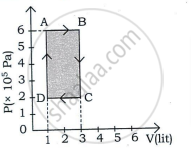
In a cyclic process, if ΔU = internal energy, W = work done, Q = Heat supplied then ______.
