Advertisements
Advertisements
प्रश्न
Give an expression for work done in an isothermal process.
Advertisements
उत्तर
The work done by the gas, W = `int_("V"_"i")^("V"_"f") "P"."dV"`
Writing pressure in terms of volume and temperature,
P = `(μ"RT")/"V"`
Substituting this value we get
W = `int_("V"_"i")^("V"_"f") (μ"RT")/"V" "dV" = μ"RT" int_("V"_"i")^("V"_"f") "dV"/"V"`
By performing the integration in equation, we get
W = `μ"RT" ln ("V"_"f"/"V"_"i")`
APPEARS IN
संबंधित प्रश्न
Draw a p-V diagram showing positive work at constant pressure.
3 mole of a gas at temperature 400 K expands isothermally from an initial volume of 4 litres to a final volume of 8 litres. Find the work done by the gas. (R = 8.31 J mol-1 K-1)
Apply first law for an isobaric process.
Give an equation state for an isochoric process.
What is a cyclic process?
What is meant by a reversible and irreversible processes?
An ideal gas is made to go from a state A to stale B in the given two different ways (see figure) (i) an isobaric and then an isochoric process and (ii) an isochoric and then an isobaric process. The work done by gas in the two processes are W1 and W2 respectively. Then,

In which of the following processes, beat is neither absorbed nor released by a system?
In an isothermal process, the volume of an ideal gas is halved. One can say that ____________.
Consider P-V diagram for an ideal gas shown in figure.
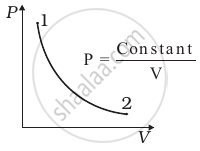
Out of the following diagrams (figure), which represents the T-P diagram?
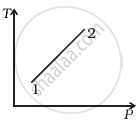 (i) |
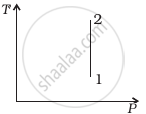 (ii) |
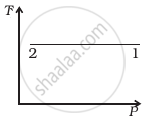 (iii) |
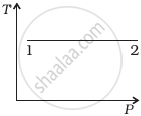 (iv) |
