Advertisements
Advertisements
प्रश्न
Give an expression for work done in an isothermal process.
Advertisements
उत्तर
The work done by the gas, W = `int_("V"_"i")^("V"_"f") "P"."dV"`
Writing pressure in terms of volume and temperature,
P = `(μ"RT")/"V"`
Substituting this value we get
W = `int_("V"_"i")^("V"_"f") (μ"RT")/"V" "dV" = μ"RT" int_("V"_"i")^("V"_"f") "dV"/"V"`
By performing the integration in equation, we get
W = `μ"RT" ln ("V"_"f"/"V"_"i")`
APPEARS IN
संबंधित प्रश्न
Explain why The climate of a harbour town is more temperate than that of a town in a desert at the same latitude.
Answer in brief.
Why should a Carnot cycle have two isothermal two adiabatic processes?
Draw a p-V diagram of the reversible process.
Draw a p-V diagram showing positive work at constant pressure.
Differentiate between the reversible and irreversible processes.
An ideal gas of volume 2 L is adiabatically compressed to (1/10)th of its initial volume. Its initial pressure is 1.01 x 10⁵ Pa, calculate the final pressure. (Given 𝛾 = 1.4)
Write a note on free expansion.
Give the equation of state for an adiabatic process.
Explain in detail an adiabatic process.
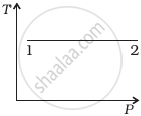
Consider P-V diagram for an ideal gas shown in figure.
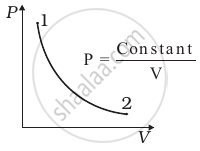
Out of the following diagrams (figure), which represents the T-P diagram?
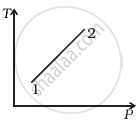 (i) |
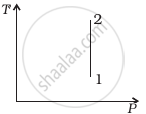 (ii) |
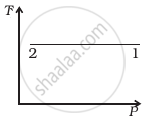 (iii) |
 (iv) |
