Advertisements
Advertisements
प्रश्न
Explain in detail the isochoric process.
Advertisements
उत्तर
Isochoric process: This is a thermodynamic process in which the volume of the system is kept constant. But pressure, temperature and internal energy continue to be variables.
The pressure-volume graph for an isochoric process is a vertical line parallel to the pressure axis as shown in Figure.

Isochoric process with increased pressure
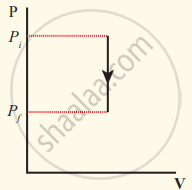
Isochoric process with decreased pressure

Isochoric process
P = `((μ"R")/"V")"T"` ...............(1)
where `((μ"R")/"V")` = constant
We can infer that the pressure is directly proportional to temperature. This implies that the P-T graph for an isochoric process is a straight line passing through the origin. If gas goes from the state (Pi, Ti) to (Pf, Tf) at constant volume, then the system satisfies the following equation
`"P"_"i"/"T"_"i" = "P"_"f"/"T"_"f"` .....,,,(2)
For an isochoric processes, ∆V = 0 and W = 0. Then the first law becomes
∆U = 0 .................(3)
Implying that the heat supplied is used to increase only the internal energy. As a result the temperature increases and pressure also increases.
Suppose a system loses heat to the surroundings through conducting walls by keeping the volume constant, then its internal energy decreases. As a result the temperature decreases; the pressure also decreases.
APPEARS IN
संबंधित प्रश्न
Give an example of some familiar process in which heat is added to an object, without changing its temperature.
Answer in brief.
Why should a Carnot cycle have two isothermal two adiabatic processes?
Draw a p-V diagram of the reversible process.
Explain the cyclic process.
The V-T diagram of an ideal gas which goes through a reversible cycle A→B→C→D is shown below. (Processes D→A and B→C are adiabatic)

The corresponding PV diagram for the process is (all figures are schematic)
Give an equation state for an isochoric process.
A monoatomic gas of pressure p having volume V expands isothermally to a volume 2V and then adiabatically to a volume 16V. The final pressure of the gas is ____________.
`("ratio of specific heats" = 5/3)`
An ideal gas is expanded isothermally from volume V1 to volume V2 and then compressed adiabatically to original volume V1. If the initial pressure is P1, the final pressure is P3 and net work done is W, then ____________.
Give any two types of a thermodynamic process.
In a cyclic process, if ΔU = internal energy, W = work done, Q = Heat supplied then ______.
