Advertisements
Advertisements
प्रश्न
A thermodynamic system is taken from an original state to an intermediate state by the linear process shown in Figure
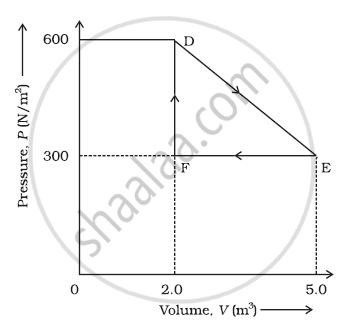
Its volume is then reduced to the original value from E to F by an isobaric process. Calculate the total work done by the gas from D to E to F
Advertisements
उत्तर १
Total work done by the gas from D to E to F = Area of ΔDEF
Area of ΔDEF =`1/2DExxEF`
Where,
DF = Change in pressure
= 600 N/m2 – 300 N/m2
= 300 N/m2
FE = Change in volume
= 5.0 m3 – 2.0 m3
= 3.0 m3
Area of ΔDEF =`1/2xx300xx3` = 450 J
Therefore, the total work done by the gas from D to E to F is 450 J.
उत्तर २
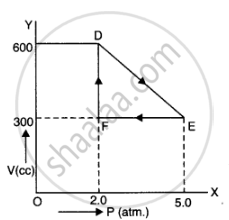
As is clear figure
Change in pressure, `triangle P = EF = 5.0 - 2.0 = 3.0 atm = 3.0 xx 10^5 Nm^(-2)`
Change in volume. triangle V = DF = 600 - 300 = 300 cc
= `300 xx 10^(-6) m^3`
Work done by the gas from D to E to F = area of `triangle DEF`
`W =1/2 xx DF xx EF`
`= 1/2 xx (300 xx 10^(-6)) xx (3.0 xx 10^5) = 45 J`
APPEARS IN
संबंधित प्रश्न
An ideal gas is taken through an isothermal process. If it does 2000 J of work on its environment, how much heat is added to it?
Heating a gas in a constant volume container is an example of which process?
Draw a p-V diagram of the irreversible process.
3 mole of a gas at temperature 400 K expands isothermally from an initial volume of 4 litres to a final volume of 8 litres. Find the work done by the gas. (R = 8.31 J mol-1 K-1)
An ideal gas of volume 2 L is adiabatically compressed to (1/10)th of its initial volume. Its initial pressure is 1.01 x 10⁵ Pa, calculate the final pressure. (Given 𝛾 = 1.4)
When you exercise in the morning, by considering your body as a thermodynamic system, which of the following is true?
The V-T diagram of an ideal gas which goes through a reversible cycle A→B→C→D is shown below. (Processes D→A and B→C are adiabatic)

The corresponding PV diagram for the process is (all figures are schematic)
Apply first law for an isothermal process.
Apply first law for an adiabatic process.
What is meant by a reversible and irreversible processes?
Derive the work done in an isothermal process.
Draw the TP diagram (P-x axis, T-y axis), VT(T-x axis, V-y axis) diagram for
- Isochoric process
- Isothermal process
- Isobaric process
An ideal gas is taken in a cyclic process as shown in the figure. Calculate
- work done by the gas
- work done on the gas
- Net work done in the process

An ideal gas is made to go from a state A to stale B in the given two different ways (see figure) (i) an isobaric and then an isochoric process and (ii) an isochoric and then an isobaric process. The work done by gas in the two processes are W1 and W2 respectively. Then,

In an isothermal process, the volume of an ideal gas is halved. One can say that ____________.
Which of the following processes is reversible?
Give any two types of a thermodynamic process.
An ideal gas is taken through a cyclic process ABCDA as shown in figure. The net work done by the gas during the cycle is ______.