Advertisements
Advertisements
प्रश्न
Explain work done during a thermodynamic process.
Advertisements
उत्तर
- Consider the system is initially at state A with its pressure is pi and volume is Vi. Let the state be indicated as coordinates (Vi, pi). It can attain the final state (Vf, pf) along different possible paths as shown in the p-V diagram below.

Different ways to change a system - Consider a system that changes its state from initial state A to final state B via path 1 as shown in the figure.
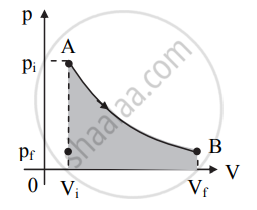
Pressure and volume both change
a. When the system changes itself from A to B, both its pressure and volume change. The pressure decreases while volume increases.
b. The work done by the system is given by the area under the curve. It is positive when the volume increases (as shown in the figure) or negative when the volume decreases. - Consider the system changes its state from A to B via path 2 as shown in figure (a).

Figure (a)
a. In this case, the volume increases to Vi from point A up to point C at the constant pressure pi.
b. After point C, the pressure of the system decreases to pf at constant volume as shown in figure (a).
c. The system thus, reaches its final state B with co-ordinates (Vf, pf). Work done in this process is represented by the shaded area under the curve in figure (a). - Consider the system changes its state from A to B via path 3 as shown in figure (b).
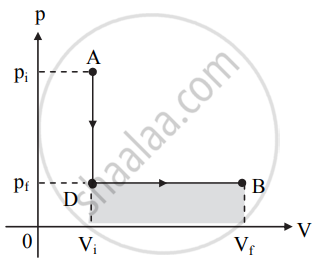
Figure (b)
a. In this case, the pressure decreases from pi to pf at constant volume Vi along the path AD.
b. After point D, the volume of the system increases to Vf at constant pressure pf as shown in figure (b). c. Work done in this process is represented by the shaded area under the curve in figure (b). - From figures (a) and (b) we can conclude that the work done is more when the system follows path ACB than the work done by the system along the path ADB.
Thus, the work done by a system in a thermodynamic process depends not only on the initial and the final states but also on the intermediate states, i.e., on the paths along which the change takes place.
APPEARS IN
संबंधित प्रश्न
Heating a gas in a constant volume container is an example of which process?
Draw a p-V diagram of the irreversible process.
Draw a p-V diagram showing positive work with varying pressure.
Draw a p-V diagram showing negative work with varying pressure.
Differentiate between the reversible and irreversible processes.
Explain thermodynamics of the adiabatic process.
The V-T diagram of an ideal gas which goes through a reversible cycle A→B→C→D is shown below. (Processes D→A and B→C are adiabatic)

The corresponding PV diagram for the process is (all figures are schematic)
Give the equation of state for an adiabatic process.
Draw the PV diagram for the isochoric process.
Can the given heat energy be completely converted to work in a cyclic process? If not, when can the heat can completely converted to work?
Derive the work done in an isothermal process.
Explain in detail the isochoric process.
What are the limitations of the first law of thermodynamics?
Draw the TP diagram (P-x axis, T-y axis), VT(T-x axis, V-y axis) diagram for
- Isochoric process
- Isothermal process
- Isobaric process
Consider the following cyclic process consist of isotherm, isochoric and isobar which is given in the figure.

Draw the same cyclic process qualitatively in the V-T diagram where T is taken along the x-direction and V is taken along the y-direction. Analyze the nature of heat exchange in each process.
A thermodynamic system undergoes cyclic process ABCDA as shown in the figure. The work done by the system is ______

A monoatomic gas of pressure p having volume V expands isothermally to a volume 2V and then adiabatically to a volume 16V. The final pressure of the gas is ____________.
`("ratio of specific heats" = 5/3)`
Among the amount of heat absorbed and the amount of work done by a system, ______
One mole of an ideal gas with `gamma` = 1.4 is adiabatically compressed so that its temperature rises from 27° C to 47° C. The change in the internal energy of the gas is (R = 8.3 J/mol.K) ____________.
In which of the following processes, beat is neither absorbed nor released by a system?
In an isothermal process, the volume of an ideal gas is halved. One can say that ____________.
Ideal gas for which 'ϒ' = 1.5 is suddenly compressed to `1/4`th of its initial volume. The ratio of 4 the final pressure to the initial pressure is ______.
`(ϒ = "C"_"p"/"C"_"v")`
The work done on the system in changing the state of a gas adiabatically from equilibrium state A to equilibrium state B is 22.4 J. If the gas is taken from state A to B through another process in which the net heat absorbed by the system is 15.5 cal, then the net work done by the system in the latter case is ______.
( l cal = 4.2 J)
Give any two types of a thermodynamic process.
In the figure shown here, the work done in the process ACBA is ______.

In a certain thermodynamical process, the pressure of a gas depends on its volume as kV3. The work done when the temperature changes from 100°C to 300°C will be ______ nR, where n denotes number of moles of a gas.
Explain the thermodynamic process.
In a cyclic process, if ΔU = internal energy, W = work done, Q = Heat supplied then ______.
