Advertisements
Advertisements
Question
Explain work done during a thermodynamic process.
Advertisements
Solution
- Consider the system is initially at state A with its pressure is pi and volume is Vi. Let the state be indicated as coordinates (Vi, pi). It can attain the final state (Vf, pf) along different possible paths as shown in the p-V diagram below.

Different ways to change a system - Consider a system that changes its state from initial state A to final state B via path 1 as shown in the figure.
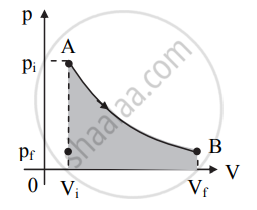
Pressure and volume both change
a. When the system changes itself from A to B, both its pressure and volume change. The pressure decreases while volume increases.
b. The work done by the system is given by the area under the curve. It is positive when the volume increases (as shown in the figure) or negative when the volume decreases. - Consider the system changes its state from A to B via path 2 as shown in figure (a).

Figure (a)
a. In this case, the volume increases to Vi from point A up to point C at the constant pressure pi.
b. After point C, the pressure of the system decreases to pf at constant volume as shown in figure (a).
c. The system thus, reaches its final state B with co-ordinates (Vf, pf). Work done in this process is represented by the shaded area under the curve in figure (a). - Consider the system changes its state from A to B via path 3 as shown in figure (b).
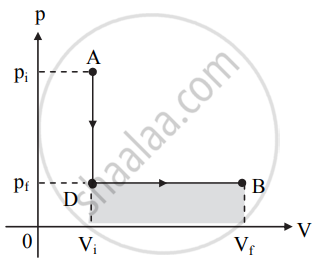
Figure (b)
a. In this case, the pressure decreases from pi to pf at constant volume Vi along the path AD.
b. After point D, the volume of the system increases to Vf at constant pressure pf as shown in figure (b). c. Work done in this process is represented by the shaded area under the curve in figure (b). - From figures (a) and (b) we can conclude that the work done is more when the system follows path ACB than the work done by the system along the path ADB.
Thus, the work done by a system in a thermodynamic process depends not only on the initial and the final states but also on the intermediate states, i.e., on the paths along which the change takes place.
APPEARS IN
RELATED QUESTIONS
Explain why The climate of a harbour town is more temperate than that of a town in a desert at the same latitude.
Give an example of some familiar process in which heat is added to an object, without changing its temperature.
Answer in brief.
Why should a Carnot cycle have two isothermal two adiabatic processes?
An ideal gas is taken through an isothermal process. If it does 2000 J of work on its environment, how much heat is added to it?
Draw a p-V diagram showing positive work with varying pressure.
Draw a p-V diagram showing negative work with varying pressure.
Draw a p-V diagram showing positive work at constant pressure.
Differentiate between the reversible and irreversible processes.
Write a note on free expansion.
Explain the thermodynamics of the isobaric process.
When a cycle tyre suddenly bursts, the air inside the tyre expands. This process is ____________.
When food is cooked in a vessel by keeping the lid closed, after some time the steam pushes the lid outward. By considering the steam as a thermodynamic system, then in the cooking process
In an isochoric process, we have ____________.
Apply first law for an adiabatic process.
Explain in detail the isothermal process.
Derive the work done in an isothermal process.
For a given ideal gas 6 × 10⁵ J heat energy is supplied and the volume of gas is increased from 4 m3 to 6 m3 at atmospheric pressure. Calculate
- the work done by the gas
- change in internal energy of the gas
- graph this process in PV and TV diagram
A monoatomic gas of pressure p having volume V expands isothermally to a volume 2V and then adiabatically to a volume 16V. The final pressure of the gas is ____________.
`("ratio of specific heats" = 5/3)`
An ideal gas is expanded isothermally from volume V1 to volume V2 and then compressed adiabatically to original volume V1. If the initial pressure is P1, the final pressure is P3 and net work done is W, then ____________.
An ideal gas A and a real gas B have their volumes increased from V to 2V under isothermal conditions. The increase in internal energy ____________.
The work done on the system in changing the state of a gas adiabatically from equilibrium state A to equilibrium state B is 22.4 J. If the gas is taken from state A to B through another process in which the net heat absorbed by the system is 15.5 cal, then the net work done by the system in the latter case is ______.
( l cal = 4.2 J)
Explain the thermodynamic process.
When an inflated ballon is suddenly burst, why is the emerging air slightly cooled?
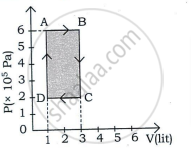
An ideal gas is taken through a cyclic process ABCDA as shown in figure. The net work done by the gas during the cycle is ______.
In a cyclic process, if ΔU = internal energy, W = work done, Q = Heat supplied then ______.
