Advertisements
Advertisements
Question
Heating a gas in a constant volume container is an example of which process?
Options
isochoric
adiabatic
isobaric
cyclic
Advertisements
Solution
isochoric
APPEARS IN
RELATED QUESTIONS
Give an example of some familiar process in which heat is added to an object, without changing its temperature.
Answer in brief.
Why should a Carnot cycle have two isothermal two adiabatic processes?
Draw a p-V diagram of the irreversible process.
Draw a p-V diagram showing positive work with varying pressure.
State the assumptions made for thermodynamic processes.
Explain the cyclic process.
An ideal gas of volume 2 L is adiabatically compressed to (1/10)th of its initial volume. Its initial pressure is 1.01 x 10⁵ Pa, calculate the final pressure. (Given 𝛾 = 1.4)
Explain the thermodynamics of the isochoric process.
When a cycle tyre suddenly bursts, the air inside the tyre expands. This process is ____________.
In an isochoric process, we have ____________.
Give an expression for work done in an isothermal process.
Apply first law for an isobaric process.
Give the equation of state for an adiabatic process.
Draw the PV diagram for the isochoric process.
What is meant by a reversible and irreversible processes?
Draw the TP diagram (P-x axis, T-y axis), VT(T-x axis, V-y axis) diagram for
- Isochoric process
- Isothermal process
- Isobaric process
In an adiabatic expansion of the air, the volume is increased by 4%, what is the percentage change in pressure? (For air γ = 1.4)
For a given ideal gas 6 × 10⁵ J heat energy is supplied and the volume of gas is increased from 4 m3 to 6 m3 at atmospheric pressure. Calculate
- the work done by the gas
- change in internal energy of the gas
- graph this process in PV and TV diagram
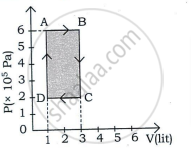
A thermodynamic system undergoes cyclic process ABCDA as shown in the figure. The work done by the system is ______

Among the amount of heat absorbed and the amount of work done by a system, ______
An ideal gas is expanded isothermally from volume V1 to volume V2 and then compressed adiabatically to original volume V1. If the initial pressure is P1, the final pressure is P3 and net work done is W, then ____________.
Two identical samples of a gas are allowed to expand (i) isothermally (ii) adiabatically. Work done is ____________.
For an isothermal expansion of a perfect gas, the value of `(Delta "P")/"P"` is equal to ____________.
Consider P-V diagram for an ideal gas shown in figure.
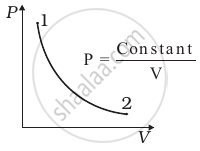
Out of the following diagrams (figure), which represents the T-P diagram?
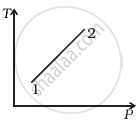 (i) |
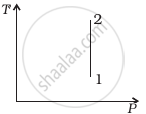 (ii) |
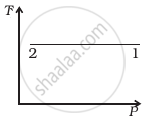 (iii) |
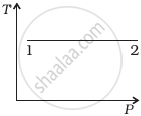 (iv) |
When an inflated ballon is suddenly burst, why is the emerging air slightly cooled?
An ideal gas is taken through a cyclic process ABCDA as shown in figure. The net work done by the gas during the cycle is ______.
Explain how can a gas be expanded at constant temperature.
In a cyclic process, if ΔU = internal energy, W = work done, Q = Heat supplied then ______.
