Advertisements
Advertisements
Question
What is a cyclic process?
Advertisements
Solution
This is a thermodynamic process in which the thermodynamic system returns to its initial state after undergoing a series of changes. Since the system comes back to the initial state, the change in the internal energy is zero. In the cyclic process, heat can flow into the system and heat flows out of the system. From the first law of thermodynamics, the net heat transferred to the system is equal to the work done by the gas.
Qnet = Qin – Qout = W (for a Cyclic Process)
APPEARS IN
RELATED QUESTIONS
Explain the thermodynamics of the isobaric process.
When a cycle tyre suddenly bursts, the air inside the tyre expands. This process is ____________.
When you exercise in the morning, by considering your body as a thermodynamic system, which of the following is true?
Apply first law for an adiabatic process.
Draw the PV diagram for the isobaric process.
A thermodynamic system undergoes cyclic process ABCDA as shown in the figure. The work done by the system is ______

A monoatomic gas of pressure p having volume V expands isothermally to a volume 2V and then adiabatically to a volume 16V. The final pressure of the gas is ____________.
`("ratio of specific heats" = 5/3)`
An ideal gas is expanded isothermally from volume V1 to volume V2 and then compressed adiabatically to original volume V1. If the initial pressure is P1, the final pressure is P3 and net work done is W, then ____________.
Ideal gas for which 'ϒ' = 1.5 is suddenly compressed to `1/4`th of its initial volume. The ratio of 4 the final pressure to the initial pressure is ______.
`(ϒ = "C"_"p"/"C"_"v")`
Consider P-V diagram for an ideal gas shown in figure.
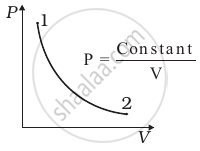
Out of the following diagrams (figure), which represents the T-P diagram?
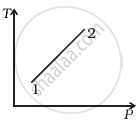 (i) |
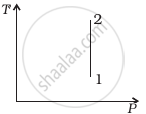 (ii) |
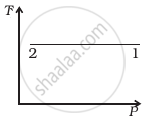 (iii) |
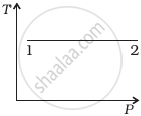 (iv) |
