Advertisements
Advertisements
Question
In an adiabatic expansion of the air, the volume is increased by 4%, what is the percentage change in pressure? (For air γ = 1.4)
Advertisements
Solution
From the equation for the adiabatic process,
PVγ = constant
Using differentiation, we get
Pγ Vγ − 1 dV + dP.Vγ = 0
`"dP"/"P" = -γ "dV"/"V"`
Volume 'V' is increased by 4% and γ = 1.4
`"dP"/"P" xx 100 = -γ ("dV"/"V" xx 100)`
= − 1.4 × 4
= − 5.6
Pressure is decreased by 5.6%
APPEARS IN
RELATED QUESTIONS
For work done to be reversible, the process should be ______
Draw a p-V diagram showing positive work with varying pressure.
The V-T diagram of an ideal gas which goes through a reversible cycle A→B→C→D is shown below. (Processes D→A and B→C are adiabatic)

The corresponding PV diagram for the process is (all figures are schematic)
Give the equation of state for an isothermal process.
Can the given heat energy be completely converted to work in a cyclic process? If not, when can the heat can completely converted to work?
In a petrol engine, (internal combustion engine) air at atmospheric pressure and temperature of 20°C is compressed in the cylinder by the piston to `1/8` of its original volume. Calculate the temperature of the compressed air. (For air γ = 1.4)
We consider a thermodynamic system. If `Delta"U"` represents the increase in its internal energy and W the work done by the system, which of the following statements is true?
Ideal gas for which 'ϒ' = 1.5 is suddenly compressed to `1/4`th of its initial volume. The ratio of 4 the final pressure to the initial pressure is ______.
`(ϒ = "C"_"p"/"C"_"v")`
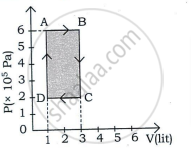
An ideal gas is taken through a cyclic process ABCDA as shown in figure. The net work done by the gas during the cycle is ______.
In a cyclic process, if ΔU = internal energy, W = work done, Q = Heat supplied then ______.
