Advertisements
Advertisements
Question
An ideal gas is taken through an isothermal process. If it does 2000 J of work on its environment, how much heat is added to it?
Advertisements
Solution
Given: W = 2000 J, isothermal process
As the gas is taken through an isothermal process, the internal energy of the gas, Δ U changes nothing and remains constant.
Therefore, the heat added to it,
Q = Δ U + W
Q = 0 + W
Q = 2000 J
APPEARS IN
RELATED QUESTIONS
A thermodynamic system is taken from an original state to an intermediate state by the linear process shown in Figure
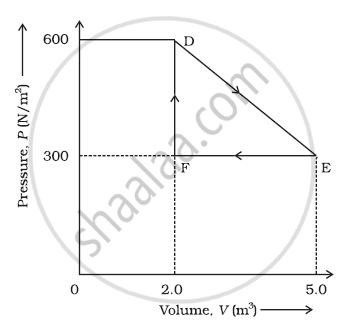
Its volume is then reduced to the original value from E to F by an isobaric process. Calculate the total work done by the gas from D to E to F
For work done to be reversible, the process should be ______
Draw a p-V diagram of the reversible process.
Draw a p-V diagram showing positive work with varying pressure.
Draw a p-V diagram showing positive work at constant pressure.
Explain the cyclic process.
Explain work done during a thermodynamic process.
When a cycle tyre suddenly bursts, the air inside the tyre expands. This process is ____________.
Apply first law for an adiabatic process.
Draw the PV diagram for the isothermal process.
What is meant by a reversible and irreversible processes?
Derive the work done in an isothermal process.
Explain in detail an adiabatic process.
A monoatomic gas of pressure p having volume V expands isothermally to a volume 2V and then adiabatically to a volume 16V. The final pressure of the gas is ____________.
`("ratio of specific heats" = 5/3)`
Among the amount of heat absorbed and the amount of work done by a system, ______
An ideal gas is expanded isothermally from volume V1 to volume V2 and then compressed adiabatically to original volume V1. If the initial pressure is P1, the final pressure is P3 and net work done is W, then ____________.
An ideal gas is made to go from a state A to stale B in the given two different ways (see figure) (i) an isobaric and then an isochoric process and (ii) an isochoric and then an isobaric process. The work done by gas in the two processes are W1 and W2 respectively. Then,

Two identical samples of a gas are allowed to expand (i) isothermally (ii) adiabatically. Work done is ____________.
In which of the following processes, beat is neither absorbed nor released by a system?
In an isothermal process, the volume of an ideal gas is halved. One can say that ____________.
An ideal gas is compressed to half its initial volume by means of several processes. Which of the process results in the maximum work done on the gas?
Ideal gas for which 'ϒ' = 1.5 is suddenly compressed to `1/4`th of its initial volume. The ratio of 4 the final pressure to the initial pressure is ______.
`(ϒ = "C"_"p"/"C"_"v")`
Explain how can a gas be expanded at constant temperature.
In a cyclic process, if ΔU = internal energy, W = work done, Q = Heat supplied then ______.
