Advertisements
Advertisements
Question
An ideal monoatomic gas is adiabatically compressed so that its final temperature is twice its initial temperature. What is the ratio of the final pressure to its initial pressure?
Advertisements
Solution 1
Data: Tf = 2Ti, monoatomic gas ∴ ϒ = 5/3
PiViϒ = PfVfϒ in an adiabatic process
Now, PV = ηRT ∴ V = `(η"RT")/"P"`
∴ Vi = `(η"RT"_"i")/"P"_"i"` and Vf = `(η"RT"_"f")/"P"_"f"`
∴ Pi `((η"RT")/"P"_"i")^ϒ="P"_"f"((η"RT"_"f")/"P"_"f")^ϒ`
∴ `"P"_"i"^(1-ϒ)"T"_"i"^ϒ="P"_"f"^(1-ϒ)"T"_"f"^ϒ`
∴ `(("T"_"f")/"T"_"i")^ϒ=(("P"_"i")/("P"_"f"))^(1-ϒ)`
∴ `(("T"_"f")/"T"_"i")^ϒ=(("P"_"f")/("P"_"i"))^(ϒ-1)`
∴ 25/3 = `(("P"_"f")/("P"_"i"))^(5//3-1)=(("P"_"f")/("P"_"i"))^(2//3)`
∴ `5/3` log 2 = `2/3` log `"P"_"f"/"p"_"i"`
∴ `5/3xx0.3010 = 2/3` log `(("P"_"f")/"P"_"i")`
∴ (2.5) (0.3010) = log `(("P"_"f")/("P"_"i"))`
∴ 0.7525 = log `("P"_"f"/"P"_"i")`
∴ `("P"_"f")/"P"_"i"` = antilog 0.7525 = 5.656
This is the ratio of the final pressure (Pf) to the initial pressure (Pi).
Solution 2
Given: Tf = 2Ti, `"P"_"f"/"P"_"i"` = ?
Formula:
`"P"_"f"/"P"_"i" = (("T"_"f")/("T"_"i"))^(gamma/(gamma - 1))`
∴ `"P"_"f"/"P"_"i" = ((2"T"_"i")/("T"_"i"))^((5"/"3)/(5"/"3 - 1))` ............`(∵ "For mono-atomic gas", gamma = 5/3)`
∴ `"P"_"f"/"P"_"i" = 2^2.5`
∴ `"P"_"f"/"P"_"i" = 5.6568`
RELATED QUESTIONS
Write mathematical equation of first law of thermodynamics for the following processes :
Adiabatic process.
Write the mathematical equation of the first law of thermodynamics for an isochoric process.
Write one statement of first law of thermodyamics and its mathematical expression.
Derive an expression for maximum work in isothermal reversible expansion of two moles of an ideal gas.
Prove that ΔH=ΔU+ΔnRT. what is the condition under which ΔU=ΔH?
Calculate the internal energy at 298K for the formation of one mole of ammonia, if the enthalpy change at constant pressure is – 42.0 kJ mol-1.
(Given: R = 8.314 J K-1 mol-1)
Two gases A and B are filled at the same pressure in separate cylinders with movable pistons of radius rA and rB, respectively. On supplying an equal amount of heat to both the systems reversibly under constant pressure, the pistons of gas A and B are displaced by 16 cm and 9 cm, respectively. If the change in their internal energy is the same, then the ratio rA/rB is equal to:
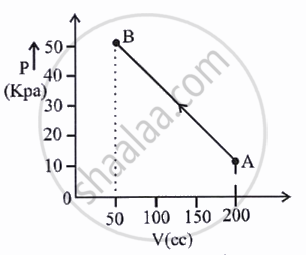
The pressure of a gas changes linearly with volume from A to B as shown in figure. If no heat is supplied to or extracted from the gas then change in the internal energy of the gas will be:
One mole of a diatomic gas (rigid molecule) does a work `|Q/2|` when the amount of heat supplied is ‘Q’. In this process the molar heat capacity of the gas is ______.
Which of the following terms is explained by the first law of thermodynamics?
What is the change in internal energy for \[\ce{2CO_{(g)} + O2_{(g)} -> 2CO2_{(g)}}\] at 25°C?
(R = 8.314 J K−1 mol−1, ΔН = −560 kJ)
