Advertisements
Advertisements
प्रश्न
For a given ideal gas 6 × 10⁵ J heat energy is supplied and the volume of gas is increased from 4 m3 to 6 m3 at atmospheric pressure. Calculate
- the work done by the gas
- change in internal energy of the gas
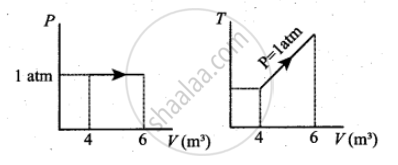
- graph this process in PV and TV diagram
Advertisements
उत्तर
Heat energy supplied to gas Q = 6 × 10⁵ J
Change in volume ∆V = (6 – 4) = 2 m3
1 atm = 1.013 × 10⁵ Nm−2
a. Work done by the gas W = P × ∆V
= 1.013 × 105 × 2
= 2.026 × 10⁵
W = 202.6 kJ
b. Change in internal energy of the gas
∆U = Q − P. ∆V
= 6 × 10⁵ − (202.6 × 10³)
= 6 × 10⁵ − 2.026 × 105
= 3.974 × 10⁵
∆U = 397.4 kJ
c.
APPEARS IN
संबंधित प्रश्न
State the assumptions made for thermodynamic processes.
Explain thermodynamics of the adiabatic process.
When a cycle tyre suddenly bursts, the air inside the tyre expands. This process is ____________.
Draw the PV diagram for the isothermal process.
Draw the PV diagram for the isobaric process.
What is a cyclic process?
Derive the work done in an adiabatic process.
A thermodynamic system undergoes cyclic process ABCDA as shown in the figure. The work done by the system is ______

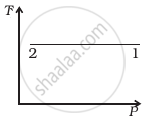
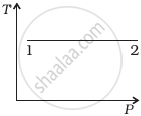
Consider P-V diagram for an ideal gas shown in figure.
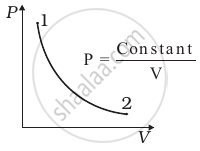
Out of the following diagrams (figure), which represents the T-P diagram?
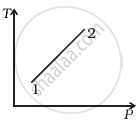 (i) |
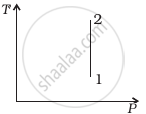 (ii) |
 (iii) |
 (iv) |
In a cyclic process, if ΔU = internal energy, W = work done, Q = Heat supplied then ______.
