Advertisements
Advertisements
Question
Apply first law for an isothermal process.
Advertisements
Solution
For an isothermal process since the temperature is constant, the internal energy is also constant. This implies that dU or ∆U = 0.
For an isothermal process, the first law of thermodynamics can be written as follows,
Q = W
APPEARS IN
RELATED QUESTIONS
Explain why The climate of a harbour town is more temperate than that of a town in a desert at the same latitude.
A thermodynamic system is taken from an original state to an intermediate state by the linear process shown in Figure
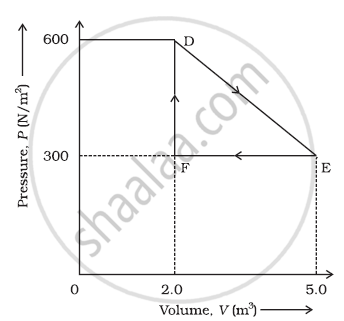
Its volume is then reduced to the original value from E to F by an isobaric process. Calculate the total work done by the gas from D to E to F
Draw a p-V diagram showing positive work at constant pressure.
Explain work done during a thermodynamic process.
A monoatomic gas of pressure p having volume V expands isothermally to a volume 2V and then adiabatically to a volume 16V. The final pressure of the gas is ____________.
`("ratio of specific heats" = 5/3)`
An ideal gas is expanded isothermally from volume V1 to volume V2 and then compressed adiabatically to original volume V1. If the initial pressure is P1, the final pressure is P3 and net work done is W, then ____________.
For an isothermal expansion of a perfect gas, the value of `(Delta "P")/"P"` is equal to ____________.
In an isothermal process, the volume of an ideal gas is halved. One can say that ____________.
We consider a thermodynamic system. If `Delta"U"` represents the increase in its internal energy and W the work done by the system, which of the following statements is true?
The work done on the system in changing the state of a gas adiabatically from equilibrium state A to equilibrium state B is 22.4 J. If the gas is taken from state A to B through another process in which the net heat absorbed by the system is 15.5 cal, then the net work done by the system in the latter case is ______.
( l cal = 4.2 J)
