Advertisements
Advertisements
Question
An electric immersion heater is rated 1250 W. Calculate the time in which it will heat 20 kg of water at 5°C to 65°C.
Advertisements
Solution
Power supplied by an electric heater (VI) = 1250 W
θ1 = Initial temperature = 5°C
m = Mass of water = 20 kg
θ2 = Final temperature = 65°C
c = specific heat capacity by heater = Heat gained by water ...(Law of calorimeter)
VIt = mc (θ2 - θ1) .....(Q = VI t)
1250 t = 20 × 4200 × 60 ....[(65°C - 5°C = 60°C)]
1250 t = 5040000
t = 40325 seconds
RELATED QUESTIONS
What do you mean by the following statement?
The heat capacity of a body is 50 JK-1?
Discuss the role of high specific heat capacity of water with reference to climate in coastal areas.
Explain the meaning of green house effect.
Give three reasons for the increase of green house gases.
A liquid X has specific heat capacity higher than the liquid Y. Which liquid is useful as heat reservoir to keep juice bottles without freezing?
The specific heat capacity of water is 1 cal/g °C.
The cold object the hot object enclosed in one box of heat-resistant material.
- What changes will occur in the two objects when temperature flows from those objects?
- Which principle can show that the energy exchange takes place between two objects only when kept in isolated system?
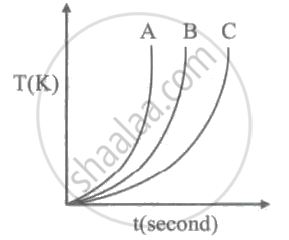
Which of the following substances (A, B and C) has the highest specific beat?
Why is water used as a coolant in radiators of a car?
