Advertisements
Advertisements
प्रश्न
An electric immersion heater is rated 1250 W. Calculate the time in which it will heat 20 kg of water at 5°C to 65°C.
Advertisements
उत्तर
Power supplied by an electric heater (VI) = 1250 W
θ1 = Initial temperature = 5°C
m = Mass of water = 20 kg
θ2 = Final temperature = 65°C
c = specific heat capacity by heater = Heat gained by water ...(Law of calorimeter)
VIt = mc (θ2 - θ1) .....(Q = VI t)
1250 t = 20 × 4200 × 60 ....[(65°C - 5°C = 60°C)]
1250 t = 5040000
t = 40325 seconds
संबंधित प्रश्न
Name the S.I. unit of heat.
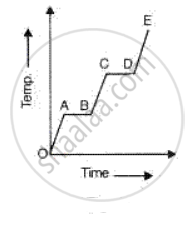
A substance is heated at a constant rate from a low temperature to a high temperature. A graph of temperature against time is shown in the figure. Which part or parts of the graph correspond(s) to the substance existing in two states?
A burner raises the temperature of 360 g of water from 40°C to 100°C in 5 minutes. Calculate the rate of heat supplied by the burner.
Write the approximate values of the specific latent heat of fusion of ice.
Why is specific heat capacity taken as a measure of thermal inertia?
Some heat is provided to a body to raise its temperature by 25°C. What will be the corresponding rise in temperature of the body as shown on the Kelvin scale?
All metals have the same specific heat capacity.
The molar specific heat of an ideal gas at constant pressure and constant volume is 'Cp' and 'Cv' respectively. If 'R' is the universal gas constant and the ratio 'Cp' to 'Cv' is 'γ' then CV = ______.
Specific heat capacity C = ______.
