Advertisements
Advertisements
Question
Explain, why do sandy soils, get heated up quickly as compared to wet soils?
Advertisements
Solution
The specific heat capacity of sand is about five times less than water. Thus,when sun shines equally on sandy soil and wet soil, the sandy soil gets heated up rapidly as compared to wet soil. It is because water absorbs large amount of heat energy, but its temperature does not rise sufficiently.
RELATED QUESTIONS
What property of water makes it an effective coolant?
What do you mean by the following statement?
The heat capacity of a body is 50 JK-1?
Equal heat is given to two objects A and B of mass 1 g. Temperature of A increases by 3°C and B by 5°C. Which object has more specific heat? And by what factor?
The specific heat capacity of a body depends on _____________ .
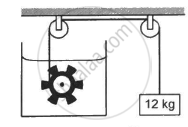
Figure shows a paddle wheel coupled to a mass of 12 kg through fixed frictionless pulleys. The paddle is immersed in a liquid of heat capacity 4200 J K−1 kept in an adiabatic container. Consider a time interval in which the 12 kg block falls slowly through 70 cm. (a) How much heat is given to the liquid? (b) How much work is done on the liquid? (c) Calculate the rise in the temperature of the liquid neglecting the heat capacity of the container and the paddle.
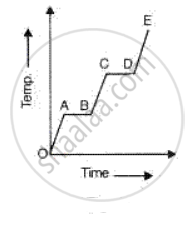
A substance is heated at a constant rate from a low temperature to a high temperature. A graph of temperature against time is shown in the figure. Which part or parts of the graph correspond(s) to the substance existing in two states?
The temperature of a lead piece of mass 400 g rises from 20°C to 50°C when 1560 J of heat is supplied to it. Calculate Specific heat capacity of lead.
Solve the following problem.
What is the specific heat of metal if 50 cal of heat is needed to raise 6 kg of the metal from 20°C to 62 °C?
Read the passage and answer the questions based on it.
If heat is exchanged between a hot and cold object, the temperature of the cold object goes on increasing due to gain of energy and the temperature of the hot object goes on decreasing due to loss of energy. The change in temperature continues till the temperatures of both objects attain the same value. In this process, the cold object gains heat energy and the hot object loses heat energy. If the system of both the objects is isolated from the environment by keeping it inside a heat-resistant box then no energy can flow from inside the box or come into the box. In this situation, we get the following principle.
Heat energy lost by the hot object = Heat energy gained by the cold object. This is called the ‘Principle of heat exchange’.
- Where does heat transfer take place?
- In such a situation which principle of heat do you perceive?
- How can this principle be explained in short?
- Measuring the property of which substance this principle is used?
Numerical Problem.
How much heat energy is required to change 2 kg of ice at 0°C into water at 20°C? (Specific latent heat of fusion of water = 3,34,000 J/kg, Specific heat capacity of water = 4200 JKg–1K–1).
