Advertisements
Advertisements
Question
Indian style of cooling drinking water is to keep it in a pitcher having porous walls. Water comes to the outer surface very slowly and evaporates. Most of energy needed for evaporation is taken from the water itself and the water is cooled down. Assume that a pitcher contains 10 kg of water and 0.2 g of water comes out per second. Assuming no backward heat transfer from the atmosphere to the water, calculate the time in which the temperature decrease by 5°C. Specific heat capacity of water = 4200 J kg−1 °C−1 and latent heat of vaporization of water = 2.27 × 10⁶ J kg−1.
Advertisements
Solution
Given:-
Specific heat of water ,S = 4200 J kg−1 °C−1
Latent heat of vapourisation of water ,L = 2.27 × 10⁶ J kg−1
Mass, M = 0.2 g = 0.0002 kg
Let us first calculate the amount of energy required to decrease the temperature of 10 kg of water by 5°C.
U1 = 10 × 4200 J/kg°C × 5°C
U1 = 210,000 = 21 × 104 J
Let the time in which the temperature is decreased by 5°C be t.
Energy required per second for evaporation of water (at the rate of 0.2 g/sec) is given by
U2 = ML
U2 = (2 × 10⁻⁴ )× (2.27 × 10⁶) = 454 J
Total energy required to decrease the temperature of the water = 454 × t
= 21 × 104 J
Now,
\[t= \frac{21 \times {10}^4}{454}\text{ seconds}\]
The time taken in minutes is given by
\[t= \frac{21 \times {10}^4}{454 \times 60} = 7 . 7\text{ minutes}\]
∴ The time required to decrease the temperature by 5°C is 7.7 minutes.
APPEARS IN
RELATED QUESTIONS
Define heat capacity and state its SI unit.
Give a mathematical relation between Heat Capacity and Specific Heat Capacity.
Name a liquid which has the highest specific heat capacity.
Write the approximate value of specific heat capacity of water in S.I. unit.
The specific heat capacity of water is :
An electric heater of power 600 W raises the temperature of 4.0 kg of a liquid from 10.0℃ to 15.0℃ in100 s. Calculate:
- the heat capacity of 4.0 kg of liquid,
- the specific heat capacity of the liquid.
45 g of water at 50°C in a beaker is cooled when 50 g of copper at 18° C is added to it. The contents are stirred till a final constant temperature is reached. Calculate this final temperature. The specific heat capacity of copper is 0.39 J g-1K-1 and that of water is 4.2 J g-1K-1. State the assumption used.
How will global warming disturb the ecological balance?
A calorimeter has mass 100 g and specific heat 0.1 kcal/ kg°C. It contains 250 gm of liquid at 30°C having specific heat of 0.4 kcal/kg°C. If we drop a piece of ice of mass 10 g at 0°C, What will be the temperature of the mixture?
The specific heat capacity of a body depends on _____________ .
What is the unit of heat capacity in CGS system?
Fill in the following blank using suitable word:
SI unit of heat is .........
Specific heat capacity of a substance A is 3.8 J g-1 K-1 and of substance B is 0.4 J g-1 k-1. Which substance is a good conductor of heat? How did you arrive at your conclusion?
A liquid X has specific heat capacity higher than the liquid Y. Which liquid is useful as heat reservoir to keep juice bottles without freezing?
Water boils at 120 °C in a pressure cooker. Explain the reason.
What is heat? What is the S. I. unit of heat?
Why is specific heat capacity taken as a measure of thermal inertia?
Explain, why is water sprayed on roads in evening in hot summer?
Specific heat capacity of substance A is 3.8 J g-1 K-1whereas the specific heat capacity of substance B is 0.4 J g-1 K-1. Which of the two is a good conductor of heat? How is one led to this conclusion?
Why are athletes advised to put on extra clothes after competing on event?
A. hot solid of mass 60 g at 100°C is placed in 150 g of water at 20° C. The final steady temperature recorded is 25°C. Calculate the specific heat capacity of the solid. [Specific heat capacity of water = 4200 J kg-1 °C-1]
Answer the following question.
Why do we generally consider two specific heats of a gas?
Solve the following problem.
What is the specific heat of metal if 50 cal of heat is needed to raise 6 kg of the metal from 20°C to 62 °C?
Consider the statement given below and choose the correct option.
Assertion: Radiation is a form of heat transfer which takes place only in vacuum.
Reason: The thermal energy is transferred from one part of a substance to another part without the actual movement of the atoms or molecules.
A diatomic gas undergoes adiabatic change. Its pressure 'P' and temperature 'T' are related as p ∝ Tx, where x is ______.
At same temperature and pressure of an ideal gas, ____________.
If 'f' is the number of degrees of freedom of a molecule of a gas and ratio of molar specific heats of a gas, ϒ = 1 + `2/"f"` where ϒ = Cp/Cv. The ratio of 'ϒ' for monoatomic gas to 'ϒ' for (rigid) f diatomic gas is ______.
The diagram below shows a cooling curve for 200 g of water. The heat is extracted at the rate of 100 Js-1. Answer the questions that follow:
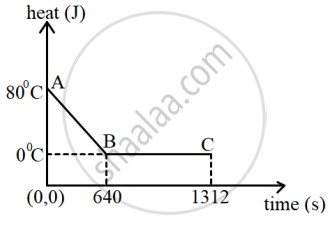
- Calculate specific heat capacity of water.
- Heat released in the region BC.
Two metals A and B have specific heat capacities in the ratio 2 : 3. If they are supplied the same amount of heat then
Which metal piece will show a greater rise in temperature given their masses is the same?
Specific heat capacity C = ______.
What is the amount of heat required to raise the temperature of 5 kg of iron from 30°C to 130°C? Specific heat capacity of iron = 483 Jkg-1C-1.
A metal ball of heat capacity 50J/°C loses 2000 J of heat. By how much will its temperature fall?
We would like to make a vessel whose volume does not change with temperature (take a hint from the problem above). We can use brass and iron `(β_(vbrass) = (6 xx 10^(–5))/K and β_(viron) = (3.55 xx 10^(–5))/K)` to create a volume of 100 cc. How do you think you can achieve this.
A block of ice of mass 120 g at temperature 0°C is put in 300 gm of water at 25°C. The xg of ice melts as the temperature of the water reaches 0°C. The value of x is ______.
[Use: Specific heat capacity of water = 4200 Jkg-1K-1, Latent heat of ice = 3.5 × 10⁵ Jkg-1]
Observe the following diagram and answer the questions given below:

Specific heat capacity of metals
- Which element has maximum specific heat capacity? Justify.
- Which element has minimum specific heat capacity? Justify.
- Define specific heat of object.
Two blocks P and Q of different metals having their mass in the ratio 2 : 1 are given same amount of heat. Their temperature rises by same amount. Compare their specific heat capacities.
Which method is used to determine the specific heat capacity of both solids and liquids by mixing a substance of unknown specific heat with water?
