Advertisements
Advertisements
Question
Describe a method to determine the specific heat capacity of a solid (say, a piece of copper).
Advertisements
Solution
First we weigh the given piece of solid and note its mass m1. Then it is heated by suspending it inside a heater. Then a known mass (say m2) of water is taken in a thin glass beaker and its temperature θ1 is recorded with a thermometer. When the given piece of solid becomes heated, its temperature θ2 is noted and it is quickly dropped into the water contained in the beaker, such that no water splashes out. The contents of beaker are well stirred and the final highest temperature θ3 is noted.
Assuming that the heat capacity of beaker is negligible and there is not heat loss to the surroundings,
Heat lost by the solid = Heat gained by water Mass of solid × Specific heat capacity of solid × Fall in temperature of solid = Mass of water × Sp. capacity of water × Rise in temperature of water.
or m1 × c × (θ2 - θ3) = m3 × 4.2 × (θ3 - θ1)
or c = `("m"_2 xx 4.2 xx (theta_3 - theta_1))/(theta_1 xx (theta_2 - theta_3))` J/g°C
Here we have assumed that specific heat capacity of water is 4.2 J/g°C.
RELATED QUESTIONS
Differentiate between heat capacity and specific heat capacity.
What do you mean by the following statement?
The heat capacity of a body is 50 JK-1?
Name and state the principle used to measure the specific heat capacity of a substance.
The specific heat capacity of a body depends on _____________ .
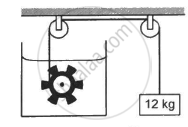
Figure shows a paddle wheel coupled to a mass of 12 kg through fixed frictionless pulleys. The paddle is immersed in a liquid of heat capacity 4200 J K−1 kept in an adiabatic container. Consider a time interval in which the 12 kg block falls slowly through 70 cm. (a) How much heat is given to the liquid? (b) How much work is done on the liquid? (c) Calculate the rise in the temperature of the liquid neglecting the heat capacity of the container and the paddle.
What change in heat energy occurs when lead at its melting point
solidifies without change in the temperature?
Ice-cream at 0°C feels colder than water at 0°C. Give reason for this observation.
A piece of ice is heated at a constant rate. The variation of temperature with heat input is shown in the graph below:

(i) What are represented by AB and CD?
(ii) What conclusion can you draw regarding the 110°c nature of ice from the above graph?
At same temperature and pressure of an ideal gas, ____________.
In the method of mixtures, a hot metal is dropped into cold water and the mixture reaches a final temperature. Which principle is used to find the specific heat of the metal?
