Advertisements
Advertisements
Question
Water falls from a height of 50 m. Calculate the rise in the temperature of water when it strikes the bottom.
(g = 10 ms-2; Specific heat capacity of water = 4200 J / kg°C)
Advertisements
Solution
If the whole of the energy due to the fall of water changes into heat energy, and 0°C be the rice in the temperature of water, then
mgh = ms θ°
Or m × 10 × 50 = m × 4200 × θ°
Or θ°, i.e. rise in temperature of water = `("m" xx 10 xx 50)/("m" xx 4200) = 5/42 ^circ "C"`
= 0.119 ° C = 0.12 ° C.
RELATED QUESTIONS
Who shall pay carbon tax ?
Define heat capacity.
Write the approximate values of the specific latent heat of vaporization of steam.
Why are athletes advised to put on extra clothes after competing on event?
All metals have the same specific heat capacity.
Consider the statement given below and choose the correct option.
Assertion: Radiation is a form of heat transfer which takes place only in vacuum.
Reason: The thermal energy is transferred from one part of a substance to another part without the actual movement of the atoms or molecules.
On supplying 100 µC of charge to a conductor, its potential rises by 5 V then capacity of the conductor is ______.
Two metals A and B have specific heat capacities in the ratio 2:3. If they are supplied same amount of heat then
If the mass ratio of metal A and metal B is 3:5 then calculate the ratio in which their temperatures rise.
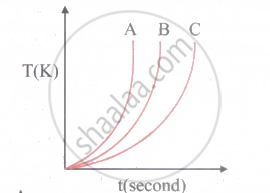
Which of the following substances (A, B and C) has the highest specific heat?
The molar specific heats of an ideal gas at constant pressure and volume are denoted by Cp and Cv, respectively. If `gamma = "C"_"p"/"C"_"v"` and R is the universal gas constant, then Cv is equal to ______.
