Advertisements
Advertisements
प्रश्न
The S.I. unit of specific heat capacity is ______.
विकल्प
J kg-1
J K-1
J kg-1 K-1
kilocal kg-10C-1
Advertisements
उत्तर
The S.I. unit of specific heat capacity is J kg-1 K-1.
APPEARS IN
संबंधित प्रश्न
A heater of power P watt raises the temperature of m kg of a liquid by Δt K in time t s. Express
the specific heat capacity of liquid in terms of above data.
How does green house effect help in keeping the temperature of earth’s surface suitable for living of human beings?
What is the specific heat capacity of boiling water?
104g of water at 30°C is taken in a calorimeter made of copper of mass 42 g. When a certain mass of ice at 0°C is added to it, the final steady temperature of the mixture after the ice has melted, was found to be 10°C. Find the mass of ice added. [Specific heat capacity of water = 4.2 Jg–1°C–1 ; Specific latent heat of fusion of ice = 336 Jg–1; Specific heat capacity of copper = 0.4 Jg–1°C–1] .
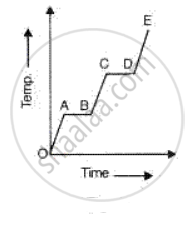
A substance is heated at a constant rate from a low temperature to a high temperature. A graph of temperature against time is shown in the figure. Which part or parts of the graph correspond(s) to the substance existing in two states?
If, in a central heating system, steam enters a radiation pipe at 100°C and water leaves the radiation pipe at 100°C, can this radiation pipe heat a room? Give an explanation for your answer.
A. hot solid of mass 60 g at 100°C is placed in 150 g of water at 20° C. The final steady temperature recorded is 25°C. Calculate the specific heat capacity of the solid. [Specific heat capacity of water = 4200 J kg-1 °C-1]
The cold object the hot object enclosed in one box of heat-resistant material.
- What changes will occur in the two objects when temperature flows from those objects?
- Which principle can show that the energy exchange takes place between two objects only when kept in isolated system?
Two metals A and B have specific heat capacities in the ratio 2:3. If they are supplied same amount of heat then
Which metal piece will have greater mass if the rise in temperature is the same for both metals?
