Advertisements
Advertisements
प्रश्न
The S.I. unit of specific heat capacity is ______.
पर्याय
J kg-1
J K-1
J kg-1 K-1
kilocal kg-10C-1
Advertisements
उत्तर
The S.I. unit of specific heat capacity is J kg-1 K-1.
APPEARS IN
संबंधित प्रश्न
Explain the term boiling point ?
Ice cream appears colder to the mouth than water at 0℃. Give reason.
Name the radiations for which the green house gases are transparent ?
How will rise in sea level affect population in coastal countries?
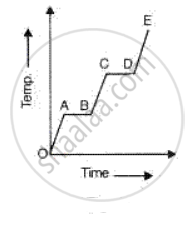
A substance is heated at a constant rate from a low temperature to a high temperature. A graph of temperature against time is shown in the figure. Which part or parts of the graph correspond(s) to the substance existing in two states?
Some heat is provided to a body to raise its temperature by 25°C. What will be the corresponding rise in temperature of the body as shown on the Kelvin scale?
1 kg of water freezes to form ice at 0°C. What amount of heat is withdrawn?
A piece of ice is heated at a constant rate. The variation of temperature with heat input is shown in the graph below:

(i) What are represented by AB and CD?
(ii) What conclusion can you draw regarding the 110°c nature of ice from the above graph?
50 g of copper is heated to increase its temperature by 10° C. If the same quantity of heat is given to 5 g water, the rise in its temperature is [Specific heat of copper = 420 joule-kg-1 °C-1 , specific heat of water = 4200 joule-kg-I °C-1]
