Advertisements
Advertisements
प्रश्न
Explain, why water is considered as best liquid for quenching thirst?
Advertisements
उत्तर
Water has the highest specific heat capacity of 4.2 Jg-1 °C-1 and hence it can absorb large amount of heat energy, without rising in temperature sufficiently. Thirst is the natural signal, when body produces more heat energy than required. Thus, water is ideal for quenching thirst, because it can absorb large amount of heat energy.
संबंधित प्रश्न
You have a choice of three metals A, B, and C, of specific heat capacities 900 Jkg-1 °C-1, 380 Jkg-1 °C-1 and 460 Jkg-1 °C-1 respectively, to make a calorimeter. Which material will you select? Justify your answer.
In an experiment to determine the specific heat capacity of a solid following operations were
made:
Mass of calorimeter + stirrer = x kg
Mass of water = y kg
Initial temperature of water t1℃
Mass of solid = z kg
Temperature of solid = t2 ℃
Temperature of mixture = t ℃
Specific heat capacity of calorimeter and water are c1 and c2 respectively. Express the specific
heat capacity c of the solid in terms of the above data.
An electric heater of power 600 W raises the temperature of 4.0 kg of a liquid from 10.0℃ to 15.0℃ in100 s. Calculate:
- the heat capacity of 4.0 kg of liquid,
- the specific heat capacity of the liquid.
Write the approximate values of the specific latent heat of fusion of ice.
A substance is in the form of a solid at 0°C. The amount of heat added to this substance and the temperature of the substance are plotted on the following graph:
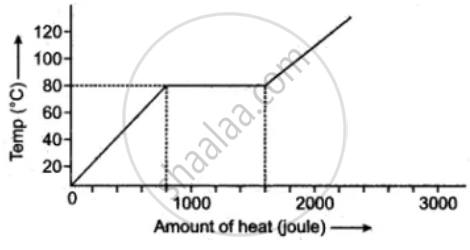
If the specific heat capacity of the solid substance is 500 J/kg °G, find from the graph, the mass of the substance.
A vessel of negligible heat*capacity contains 40g of ice in it at 0°C, 8g of steam at 100°C is passed into the ice to melt it. Find the final temperature of the contents of the vessel.
(Specific latent heat of vaporization of steam = 2268 J/g, specific latent heat of fusion of ice = 336 J/f and specific heat capacity of water = 4.2 J/g°C)
Answer the following question.
Why do we generally consider two specific heats of a gas?
Define specific heat capacity.
If 'f' is the number of degrees of freedom of a molecule of a gas and ratio of molar specific heats of a gas, ϒ = 1 + `2/"f"` where ϒ = Cp/Cv. The ratio of 'ϒ' for monoatomic gas to 'ϒ' for (rigid) f diatomic gas is ______.
