Advertisements
Advertisements
प्रश्न
A substance is in the form of a solid at 0°C. The amount of heat added to this substance and the temperature of the substance are plotted on the following graph:
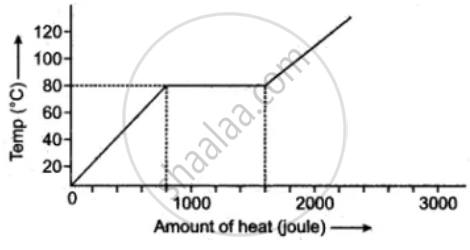
If the specific heat capacity of the solid substance is 500 J/kg °G, find from the graph, the mass of the substance.
Advertisements
उत्तर
From graph heat supplied is 800 joule during change in temperature from 0 to 80°C.
Heat = Mass × Sp. heat capacity × Rise in temperature
800 = m × 500 × 80
m = `1/50` kg
m = 20 g
संबंधित प्रश्न
The coolant in a chemical or a nuclear plant (i.e., the liquid used to prevent the different parts of a plant from getting too hot) should have high specific heat.
What do you mean by the following statement?
The specific heat capacity of copper is 0. 4 Jg-1 K-1?
45 g of water at 50°C in a beaker is cooled when 50 g of copper at 18° C is added to it. The contents are stirred till a final constant temperature is reached. Calculate this final temperature. The specific heat capacity of copper is 0.39 J g-1K-1 and that of water is 4.2 J g-1K-1. State the assumption used.
How will global warming disturb the ecological balance?
A certain amount of heat Q will warm 1 g of material X by 3°C and 1 g of material Y by 4°C. Which material has a higher specific heat capacity?
Calculate the ratio of two specific heats of polyatomic gas molecules.
Decide the unit for specific heat capacity.
For a gas, `"R"/"C"_"v"=0.4`, where R Is universal gas constant and Cv is the molar specific heat at constant volume. The gas is made up of molecules, which are ______
Specific heat capacity C = ______.
The specific heat capacity of water is ______.
