Advertisements
Advertisements
प्रश्न
To study energy exchange between hot and cold objects, the system of both objects is isolated from the environment by keeping them inside ______.
विकल्प
a heat-resistant box
a rectangular box
Hope’s apparatus
None of these
Advertisements
उत्तर
To study energy exchange between hot and cold objects, the system of both objects is isolated from the environment by keeping them inside a heat resistant box.
APPEARS IN
संबंधित प्रश्न
What amount of heat must be supplied to 2.0 x 10⁻² kg of nitrogen (at room temperature) to raise its temperature by 45 °C at constant pressure? (Molecular mass of N2 = 28; R = 8.3 J mol-1 K-1.)
Specific heat capacity of substance A is 3.8 J g-1K-1 whereas the specific heat capacity of substance B is 0.4 J g-1 K-1
(i) Which of the two is a good conductor of heat?
(ii) How is one led to the above conclusion?
(iii) If substances A and B are liquids then which one would be more useful in car radiators?
Differentiate between heat capacity and specific heat capacity.
Write the expression for the heat energy Q received by the substance when m kg of substance of specific heat capacity c Jkg-1 k-1 is heated through Δt° C.
In an experiment to determine the specific heat capacity of a solid following operations were
made:
Mass of calorimeter + stirrer = x kg
Mass of water = y kg
Initial temperature of water t1℃
Mass of solid = z kg
Temperature of solid = t2 ℃
Temperature of mixture = t ℃
Specific heat capacity of calorimeter and water are c1 and c2 respectively. Express the specific
heat capacity c of the solid in terms of the above data.
What is carbon tax?
The specific heat capacity of a body depends on _____________ .
A substance is heated at a constant rate from a low temperature to a high temperature. A graph of temperature against time is shown in the figure. Which part or parts of the graph correspond(s) to the substance existing in two states?
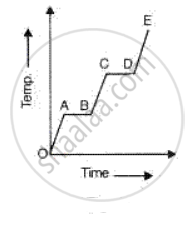
Specific heat capacity of a substance A is 3.8 J g-1 K-1 and of substance B is 0.4 J g-1 k-1. Which substance is a good conductor of heat? How did you arrive at your conclusion?
State the condition for the flow of heat energy from one body to another.
Explain, why is water sprayed on roads in evening in hot summer?
Explain, why temperature in hot summer, falls sharply after a sharp shower?
Is it possible to condense the water formed, back to ice by adding ice at 0°C. Explain with reason.
A. hot solid of mass 60 g at 100°C is placed in 150 g of water at 20° C. The final steady temperature recorded is 25°C. Calculate the specific heat capacity of the solid. [Specific heat capacity of water = 4200 J kg-1 °C-1]
State factors on which the amount of heat radiated by a body depends.
Two metals A and B have specific heat capacities in the ratio 2:3. If they are supplied same amount of heat then
If specific heat capacity of metal A is 0.26 Jg-1 0C-1 then calculate the specific heat capacity of metal B.
Give one example where high specific heat capacity of water is used as heat reservoir.
Which method is used to determine the specific heat capacity of both solids and liquids by mixing a substance of unknown specific heat with water?
