Advertisements
Advertisements
प्रश्न
The temperature of 170 g of water at 50°C is lowered to 5°C by adding a certain amount of ice to it. Find the mass of ice added.
Given: Specific heat capacity of water = 4200 J kg-1 °C-1 and specific latent heat of ice = 336000 J kg-1.
Advertisements
उत्तर
Given mass of water = 170 g = 1.17 kg,
Initial temperature = 50°C
Fall in temperature = Δt = (50 - 5) = 45°C = 45K
Heat lost by water = mc Δt
= 0.17 × 4200 × 45
= 3.213 × 10⁴ J
If m' kg ice is added, heat gained by it to melt to 0°C = m'L
= m'C Δt
= m' × 4200 × 5
= m' × 2.1 × 10⁴ J
Total heat gained by ice
= 3.36 × 10⁵ m' + 2.1 × 10⁴ m'
= 3.57 × 10⁵ m' J
By the principle of method of mixtures heat lost by water = heat gained by ice
⇒ 3.213 × 104 = 3.57 × 10⁵ m'
⇒ m' = `(3.213 xx 10^4)/(3.57 xx 10^5)`
⇒ m' = 0.09 kg (90 g)
संबंधित प्रश्न
Given below are observations on molar specific heats at room temperature of some common gases.
| Gas |
Molar specific heat (Cv) (cal mol–1 K–1) |
| Hydrogen | 4.87 |
| Nitrogen | 4.97 |
| Oxygen | 5.02 |
| Nitric oxide | 4.99 |
| Carbon monoxide | 5.01 |
| Chlorine | 6.17 |
The measured molar specific heats of these gases are markedly different from those for monatomic gases. Typically, molar specific heat of a monatomic gas is 2.92 cal/mol K. Explain this difference. What can you infer from the somewhat larger (than the rest) value for chlorine?
Discuss the role of high specific heat capacity of water with reference to climate in coastal areas.
Explain the meaning of green house effect.
Name three fossil fuels that emit carbon dioxide into the atmosphere ?
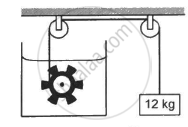
Figure shows a paddle wheel coupled to a mass of 12 kg through fixed frictionless pulleys. The paddle is immersed in a liquid of heat capacity 4200 J K−1 kept in an adiabatic container. Consider a time interval in which the 12 kg block falls slowly through 70 cm. (a) How much heat is given to the liquid? (b) How much work is done on the liquid? (c) Calculate the rise in the temperature of the liquid neglecting the heat capacity of the container and the paddle.
104g of water at 30°C is taken in a calorimeter made of copper of mass 42 g. When a certain mass of ice at 0°C is added to it, the final steady temperature of the mixture after the ice has melted, was found to be 10°C. Find the mass of ice added. [Specific heat capacity of water = 4.2 Jg–1°C–1 ; Specific latent heat of fusion of ice = 336 Jg–1; Specific heat capacity of copper = 0.4 Jg–1°C–1] .
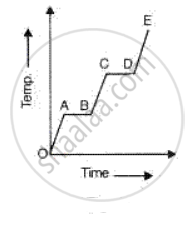
A substance is heated at a constant rate from a low temperature to a high temperature. A graph of temperature against time is shown in the figure. Which part or parts of the graph correspond(s) to the substance existing in two states?
Ice-cream at 0°C feels colder than water at 0°C. Give reason for this observation.
Specific heat capacity of a substance X is 1900 Jkg-1°C-1 means ______.
