Advertisements
Advertisements
Question
Calculate the ratio of two specific heats of polyatomic gas molecules.
Advertisements
Solution
- Gases that have molecules containing more than two atoms are termed polyatomic gases.
- Each molecule of the polyatomic gas has 3 translational degrees of freedom. Only linear molecules have 2 degrees of freedom for rotation. All other polyatomic molecules have 3 degrees of freedom for rotation.
- The number of degrees of freedom (f) for the vibrational motion of a polyatomic molecule depends on the geometric structure of the molecule, i.e., the arrangement of atoms in a molecule.
- Each such degree of freedom contributes average energy `2 xx 1/2`kBT from kinetic energy and potential energy terms.
- Therefore for 1 mole of a polyatomic gas, the internal energy is E = `3/2 N_Ak_BT + 3/2 N_Ak_BT + f × 2/2 N_Ak_BT`
= (3 + f) NAkBT - Molar-specificific heats at constant volume and constant pressure are given as
Cv = (3 + f) R and Cp = (4 + f) R
∴ `gamma = C_p/C_v = (4 + f)/(3 + f)`
RELATED QUESTIONS
The coolant in a chemical or a nuclear plant (i.e., the liquid used to prevent the different parts of a plant from getting too hot) should have high specific heat.
What property of water makes it an effective coolant?
Heat supplied to a solid change it into liquid. What is this change in the phase called?
Write the approximate value of specific heat capacity of water in S.I. unit.
What do you mean by the following statement?
The heat capacity of a body is 50 JK-1?
Explain the term boiling ?
What is meant by global warming?
How will global warming disturb the ecological balance?
How will you prove experimentally that different substances have different specific heat capacities?
The ratio of specific heat capacity to molar heat capacity of a body _____________ .
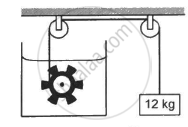
Figure shows a paddle wheel coupled to a mass of 12 kg through fixed frictionless pulleys. The paddle is immersed in a liquid of heat capacity 4200 J K−1 kept in an adiabatic container. Consider a time interval in which the 12 kg block falls slowly through 70 cm. (a) How much heat is given to the liquid? (b) How much work is done on the liquid? (c) Calculate the rise in the temperature of the liquid neglecting the heat capacity of the container and the paddle.
(b) 2000 J of heat energy is required to raise the temperature of 4 kg of a
metal by 3°c. Which expression gives the specific heat capacity of the metal?
What change in heat energy occurs when lead at its melting point
solidifies without change in the temperature?
Define heat capacity.
Water boils at 120 °C in a pressure cooker. Explain the reason.
m kg of a substance of specific heat capacity s J/kg °C is heated so that its temperature rises from θ1°C to θ2°C. Write down the expression for the heat Q supplied.
Name the substance which has maximum specific heat capacity.
Write the approximate values of the specific latent heat of vaporization of steam.
The farmers fill their fields with water in winter. Give reason.
Explain, why is water sprayed on roads in evening in hot summer?
If, in a central heating system, steam enters a radiation pipe at 100°C and water leaves the radiation pipe at 100°C, can this radiation pipe heat a room? Give an explanation for your answer.
A substance is in the form of a solid at 0°C. The amount of heat added to this substance and the temperature of the substance are plotted on the following graph:
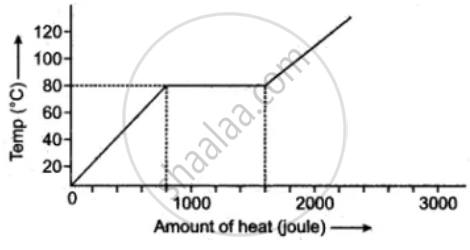
If the specific heat capacity of the solid substance is 500 J/kg °G, find from the graph, the mass of the substance.
All metals have the same specific heat capacity.
If 'Cp' and 'Cv' are molar specific heats of an ideal gas at constant pressure and volume respectively. If 'λ' is the ratio of two specific heats and 'R' is universal gas constant then 'Cp' is equal to ______.
The value of 'γ' for a gas is given as `gamma = 1 + 2/"f"`, where 'f ' is the number of degrees of freedom of freedom of a molecule of a gas. What is the ratio of `gamma_"monoatonic"//gamma_"diatomic"`?
Diatomic gas consists of rigid gas molecules
The specific heat capacity of ______ is maximum.
The difference between the two molar specific heats of gas is 9000 J/kg K. If the ratio of the two specific heats is 1.5, calculate the two molar specific heats.
A geyser heats water flowing at a rate of 2.0 kg per minute from 30°C to 70°C. If the geyser operates on a gas burner, the rate of combustion of fuel will be ______ g min-1.
[Heat of combustion = 8 × 10³ Jg-1 Specific heat of water = 4.2 Jg-1°C-1]
In the method of mixtures, a hot metal is dropped into cold water and the mixture reaches a final temperature. Which principle is used to find the specific heat of the metal?
