Advertisements
Advertisements
प्रश्न
A child running a temperature of 101°F is given an antipyrin (i.e. a medicine that lowers fever) which causes an increase in the rate of evaporation of sweat from his body. If the fever is brought down to 98 °F in 20 min, what is the average rate of extra evaporation caused, by the drug? Assume the evaporation mechanism to be the only way by which heat is lost. The mass of the child is 30 kg. The specific heat of human body is approximately the same as that of water, and latent heat of evaporation of water at that temperature is about 580 cal g–1.
Advertisements
उत्तर १
Initial temperature of the body of the child, T1 = 101°F
Final temperature of the body of the child, T2 = 98°F
Change in temperature, ΔT = `[(101 - 98 xx 5/9)]` °C
Time taken to reduce the temperature, t = 20 min
Mass of the child, m = 30 kg = 30 × 103 g
Specific heat of the human body = Specific heat of water = c
= 1000 cal/kg/ °C
Latent heat of evaporation of water, L = 580 cal g–1
The heat lost by the child is given as: `triangle theta = mc triangleT`
`= 30xx1000xx(101-98)xx5/9`
= 50000 cal
Let m1 be the mass of the water evaporated from the child’s body in 20 min.
Loss of heat through water is given by:
`triangle theta = m_1L`
`:. m_1 = (triangle theta)/L`
`= 50000/580 = 86.2 g`
∴Average rate of extra evaporation caused by the drug = `m_1/t`
`= 86.2/200 = 4.3 "g/min"`
उत्तर २
Decrease of temperature, Δt
`= 101^@ F - 98^@ F = 3^@ F = 3xx5/9 ""^@C = 1.67^@C`
Specific heat of water = `1000 "cal kg"^(-1) ""^@C^(-1)`
heat lost = `30 kg xx 1000 "cal kg"^(-1) ""^@C^(-1) xx 1.67 ""^@C = 50100 "cal"`
if m' be the mass of water evaporated then
`m' = (50100 " cal")/(580xx10^3xx "cak kg"^(-1)) = 0.086 kg`
This much water has taken 20 minutes to evaporate.
So rate of evaporation = `(0.086 kg)/(20 min) = (86 g)/(20 min)`
= 4.3 g`"min"^(-1)`
APPEARS IN
संबंधित प्रश्न
Given below are observations on molar specific heats at room temperature of some common gases.
| Gas |
Molar specific heat (Cv) (cal mol–1 K–1) |
| Hydrogen | 4.87 |
| Nitrogen | 4.97 |
| Oxygen | 5.02 |
| Nitric oxide | 4.99 |
| Carbon monoxide | 5.01 |
| Chlorine | 6.17 |
The measured molar specific heats of these gases are markedly different from those for monatomic gases. Typically, molar specific heat of a monatomic gas is 2.92 cal/mol K. Explain this difference. What can you infer from the somewhat larger (than the rest) value for chlorine?
A geyser heats water flowing at the rate of 3.0 litres per minute from 27 °C to 77 °C. If the geyser operates on a gas burner, what is the rate of consumption of the fuel if its heat of combustion is 4.0 × 10⁴ J/g?
Calculate the mass of ice required to lower the temperature of 300 g of water 40°C to water at 0°C.
(Specific latent heat of ice = 336 J/g, the Specific heat capacity of water = 4.2J/g°C)
What do you understand by the following statements:
The specific heat capacity of lead is 130 Jkg-1K-1.
State two factors upon which the heat absorbed by a body depends
Water in lakes and ponds do not freeze at once in cold countries. Give a reason is support of your answer.
Heat supplied to a solid change it into liquid. What is this change in the phase called?
Name a liquid which has the highest specific heat capacity.
Water property of water makes it an effective coolant?
Find the time taken by a 500 W heater to raise the temperature of 50 kg of material of specific heat capacity 960 J kg-1K-1, from 18°C to 38° C. Assume that all the heat energy supplied by the heater is given to the material.
45 g of water at 50°C in a beaker is cooled when 50 g of copper at 18° C is added to it. The contents are stirred till a final constant temperature is reached. Calculate this final temperature. The specific heat capacity of copper is 0.39 J g-1K-1 and that of water is 4.2 J g-1K-1. State the assumption used.
Explain the meaning of green house effect.
Name two green house gases ?
Name the radiations for which the green house gases are opaque ?
State the impact of global warming on life on the earth.
Read the following paragraph and answer the questions.
|
If heat is exchanged between a hot and cold object, the temperature of the cold object goes on increasing due to gain of energy and the temperature of the hot object goes on decreasing due to loss of energy. The change in temperature continues till the temperatures of both the objects attain the same value. In this process, the cold object gains heat energy and the hot object loses heat energy. If the system of both the objects is isolated from the environment by keeping it inside a heat resistant box (meaning that the energy exchange takes place between the two objects only), then no energy can flow from inside the box or come into the box. |
- Heat is transferred from where to where?
- Which principle do we learn about from this process?
- How will you state the principle briefly?
- Which property of the substance is measured using this principle?
The product of mass and specific heat is known as ..........
What is the unit of heat capacity in CGS system?
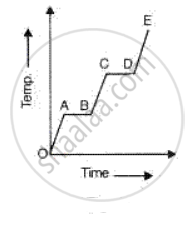
A substance is heated at a constant rate from a low temperature to a high temperature. A graph of temperature against time is shown in the figure. Which part or parts of the graph correspond(s) to the substance existing in two states?
Explain, why do sandy soils, get heated up quickly as compared to wet soils?
Give two reasons as to why copper is preferred over other metals for making calorimeters.
The temperature of a lead piece of mass 400 g rises from 20°C to 50°C when 1560 J of heat is supplied to it. Calculate Specific heat capacity of lead.
How much heat energy is released when 5 g of water at 20° C changes to ice at 0° C?
[Specific heat capacity of water = 4.2 J g-1 ° C-1 Specific latent heat of fusion of ice = 336 J g-1]
A piece of iron of mass 2.0 kg has a thermal capacity of 966 J/°C. What is its specific heat capacity in S.I. units?
Answer the following question.
Why do we generally consider two specific heats of a gas?
Derive Mayer’s relation.
From the options given below the specific heat of _______ is maximum.
The specific heat capacity of water is 1 cal/g °C.
_______ is defined as the amount of heat required to raise the temperature of 1kg of a substance by 1°C.
Define specific heat capacity.
What is specific heat capacity?
When a uniform rod is heated, which of the following quantity of the rod will increase
The molar specific heats of an ideal gas at constant pressure and constant volume are denoted by Cp and Cv respectively. If `gamma = "C"_"p"/"C"_"v"` and R is the universal gas constant, then Cp is equal to ______.
If 'f' is the number of degrees of freedom of a molecule of a gas and ratio of molar specific heats of a gas, ϒ = 1 + `2/"f"` where ϒ = Cp/Cv. The ratio of 'ϒ' for monoatomic gas to 'ϒ' for (rigid) f diatomic gas is ______.
A metal ball of heat capacity 50J/°C loses 2000 J of heat. By how much will its temperature fall?
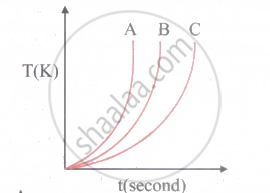
Which of the following substances (A, B and C) has the highest specific heat?
The difference between the two molar specific heats of gas is 9000 J/kg K. If the ratio of the two specific heats is 1.5, calculate the two molar specific heats.
The molar specific heats of an ideal gas at constant pressure and volume are denoted by Cp and Cv, respectively. If `gamma = "C"_"p"/"C"_"v"` and R is the universal gas constant, then Cv is equal to ______.
