Advertisements
Advertisements
प्रश्न
A child running a temperature of 101°F is given an antipyrin (i.e. a medicine that lowers fever) which causes an increase in the rate of evaporation of sweat from his body. If the fever is brought down to 98 °F in 20 min, what is the average rate of extra evaporation caused, by the drug? Assume the evaporation mechanism to be the only way by which heat is lost. The mass of the child is 30 kg. The specific heat of human body is approximately the same as that of water, and latent heat of evaporation of water at that temperature is about 580 cal g–1.
Advertisements
उत्तर १
Initial temperature of the body of the child, T1 = 101°F
Final temperature of the body of the child, T2 = 98°F
Change in temperature, ΔT = `[(101 - 98 xx 5/9)]` °C
Time taken to reduce the temperature, t = 20 min
Mass of the child, m = 30 kg = 30 × 103 g
Specific heat of the human body = Specific heat of water = c
= 1000 cal/kg/ °C
Latent heat of evaporation of water, L = 580 cal g–1
The heat lost by the child is given as: `triangle theta = mc triangleT`
`= 30xx1000xx(101-98)xx5/9`
= 50000 cal
Let m1 be the mass of the water evaporated from the child’s body in 20 min.
Loss of heat through water is given by:
`triangle theta = m_1L`
`:. m_1 = (triangle theta)/L`
`= 50000/580 = 86.2 g`
∴Average rate of extra evaporation caused by the drug = `m_1/t`
`= 86.2/200 = 4.3 "g/min"`
उत्तर २
Decrease of temperature, Δt
`= 101^@ F - 98^@ F = 3^@ F = 3xx5/9 ""^@C = 1.67^@C`
Specific heat of water = `1000 "cal kg"^(-1) ""^@C^(-1)`
heat lost = `30 kg xx 1000 "cal kg"^(-1) ""^@C^(-1) xx 1.67 ""^@C = 50100 "cal"`
if m' be the mass of water evaporated then
`m' = (50100 " cal")/(580xx10^3xx "cak kg"^(-1)) = 0.086 kg`
This much water has taken 20 minutes to evaporate.
So rate of evaporation = `(0.086 kg)/(20 min) = (86 g)/(20 min)`
= 4.3 g`"min"^(-1)`
APPEARS IN
संबंधित प्रश्न
What amount of heat must be supplied to 2.0 x 10⁻² kg of nitrogen (at room temperature) to raise its temperature by 45 °C at constant pressure? (Molecular mass of N2 = 28; R = 8.3 J mol-1 K-1.)
A refrigerator converts 100 g of water at 20°C to ice at -10°C in 35 minutes. Calculate the average rate of heat extraction in terms of watts.
Given: Specific heat capacity of ice = 2.1 J g-1°C-1
Specific heat capacity of water = 4.2 J g-1°C-1
Specific latent heat of fusion of ice = 336 J g-1
The temperature of 170 g of water at 50°C is lowered to 5°C by adding a certain amount of ice to it. Find the mass of ice added.
Given: Specific heat capacity of water = 4200 J kg-1 °C-1 and specific latent heat of ice = 336000 J kg-1.
Discuss the role of high specific heat capacity of water with reference to climate in coastal areas.
Water is used in hot water bottles for fomentation. Give a reason.
Find the time taken by a 500 W heater to raise the temperature of 50 kg of material of specific heat capacity 960 J kg-1K-1, from 18°C to 38° C. Assume that all the heat energy supplied by the heater is given to the material.
An electric heater of power 600 W raises the temperature of 4.0 kg of a liquid from 10.0℃ to 15.0℃ in100 s. Calculate:
- the heat capacity of 4.0 kg of liquid,
- the specific heat capacity of the liquid.
45 g of water at 50°C in a beaker is cooled when 50 g of copper at 18° C is added to it. The contents are stirred till a final constant temperature is reached. Calculate this final temperature. The specific heat capacity of copper is 0.39 J g-1K-1 and that of water is 4.2 J g-1K-1. State the assumption used.
Explain the term boiling point ?
What is carbon tax?
Without green house effect, the average temperature of earth’s surface would have been:
(a) – 18℃
(b) 33℃
(c) 0℃
(d) 15℃
What is meant by specific heat capacity?
(i) State whether the specific heat capacity of a substance remains the same when its state changes from solid to liquid.
(ii) Give one example to support your answer.
A liquid X has specific heat capacity higher than the liquid Y. Which liquid is useful as heat reservoir to keep juice bottles without freezing?
m kg of a substance of specific heat capacity s J/kg °C is heated so that its temperature rises from θ1°C to θ2°C. Write down the expression for the heat Q supplied.
Write two advantages of high specific heat capacity of water.
The farmers fill their fields with water in winter. Give reason.
Explain, why is water sprayed on roads in evening in hot summer?
An equal quantity of heat is supplied to two substances A and B. The substance A shows a greater rise in temperature. What can you say about the heat capacity of A as compared to that of B?
A substance is in the form of a solid at 0°C. The amount of heat added to this substance and the temperature of the substance are plotted on the following graph:
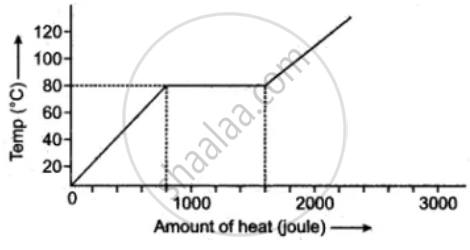
If the specific heat capacity of the solid substance is 500 J/kg °G, find from the graph, the mass of the substance.
How much heat energy is released when 5 g of water at 20° C changes to ice at 0° C?
[Specific heat capacity of water = 4.2 J g-1 ° C-1 Specific latent heat of fusion of ice = 336 J g-1]
Write the name.
The amount of heat absorbed at constant temperature by unit mass of a liquid to convert into gaseous phase.
All metals have the same specific heat capacity.
Explain how heat capacity of a solid can be determined by the method of mixture.
Numerical Problem.
What is the heat in joules required to raise the temperature of 25 grams of water from 0°C to 100°C? What is the heat in Calories? (Specific heat of water = `(4.18"J")/("g"°"C")`
When a uniform rod is heated, which of the following quantity of the rod will increase
Express the change in internal energy in terms of molar specific heat capacity.
A diatomic gas undergoes adiabatic change. Its pressure 'P' and temperature 'T' are related as p ∝ Tx, where x is ______.
If 'Cp' and 'Cv' are molar specific heats of an ideal gas at constant pressure and volume respectively. If 'λ' is the ratio of two specific heats and 'R' is universal gas constant then 'Cp' is equal to ______.
Which of the substances P, Q, or R has the lowest specific heat? The temperature v/s time graph is shown ______.

At same temperature and pressure of an ideal gas, ____________.
An office room contains about 4000 moles of air. The change in the internal energy of this much air when it is cooled from 34° C to 19° C at a constant pressure of 1.0 atm is (Use `gamma_"air"` = 1.4 and Universal gas constant = 8.314 J / mol K) ____________.
Two metals A and B have specific heat capacities in the ratio 2:3. If they are supplied same amount of heat then
If specific heat capacity of metal A is 0.26 Jg-1 0C-1 then calculate the specific heat capacity of metal B.
Give one example where high specific heat capacity of water is used as heat reservoir.
Which method is used to determine the specific heat capacity of both solids and liquids by mixing a substance of unknown specific heat with water?
