Advertisements
Advertisements
प्रश्न
The ratio of specific heat capacity to molar heat capacity of a body _____________ .
पर्याय
is a universal constant
depends on the mass of the body
depends of the molecular weight of the body
is dimensionless
Advertisements
उत्तर
depends of the molecular weight of the body
Specific heat capacity of a body,
\[s = \frac{Q}{m\Delta\theta}\]
Here,
Q = Heat supplied
m = Mass of body
Δθ = Change in temperature
Molar heat capacity of a body,
\[C = \frac{Q}{n\Delta\theta}\]
Here,
Q = Heat supplied
n = Number of moles
Δθ = Change in temperature
∴ The ratio of the specific heat capacity and molar heat capacity is given by
\[\frac{s}{C} = \frac{\frac{Q}{m\Delta\theta}}{\frac{Q}{n\Delta\theta}} = \frac{n}{m} = \frac{n}{nM} = \frac{1}{M}\]
Here,
M = Molar mass related to number of moles
m = Mass
As the value of M is different for different bodies of different composition, the ratio cannot be a universal constant.
Also, the ratio is independent of the mass of the body.
The ratio of the specific heat and molar heat capacity depends on the molecular weight of the body.
Clearly, the unit of molecular weight is kg/mole. So, the ratio that depends only on the molecular weight cannot be dimensionless.
APPEARS IN
संबंधित प्रश्न
Given below are observations on molar specific heats at room temperature of some common gases.
| Gas |
Molar specific heat (Cv) (cal mol–1 K–1) |
| Hydrogen | 4.87 |
| Nitrogen | 4.97 |
| Oxygen | 5.02 |
| Nitric oxide | 4.99 |
| Carbon monoxide | 5.01 |
| Chlorine | 6.17 |
The measured molar specific heats of these gases are markedly different from those for monatomic gases. Typically, molar specific heat of a monatomic gas is 2.92 cal/mol K. Explain this difference. What can you infer from the somewhat larger (than the rest) value for chlorine?
Define heat capacity and state its SI unit.
A refrigerator converts 100 g of water at 20°C to ice at -10°C in 35 minutes. Calculate the average rate of heat extraction in terms of watts.
Given: Specific heat capacity of ice = 2.1 J g-1°C-1
Specific heat capacity of water = 4.2 J g-1°C-1
Specific latent heat of fusion of ice = 336 J g-1
A solid metal weighing 150 g melts at its melting point of 800 °C by providing heat at the rate of 100 W. The time taken for it to completely melt at the same temperature is 4 min. What is the specific latent heat of fusion of the metal?
Give one example where high specific heat capacity of water is used as heat reservoir ?
Describe a method to determine the specific heat capacity of a solid, like a piece of copper ?
The specific heat capacity of water is :
Explain the term boiling point ?
Ice cream appears colder to the mouth than water at 0℃. Give reason.
Name the radiations for which the green house gases are opaque ?
How will rise in sea level affect population in coastal countries?
State three ways to minimize the global warming.
How will you prove experimentally that different substances have different specific heat capacities?
Study the following procedure and answer the questions below:
1. Take 3 spheres of iron, copper and lead of equal mass.
2. Put all the 3 spheres in boiling water in a beaker for some time.
3. Take 3 spheres out of the water. Put them immediately on a thick slab of wax.
4. Note, the depth that each sphere goes into the wax.
i) Which property of substance can be studied with this procedure?
ii) Describe that property in minimum words.
iii) Explain the rule of heat exchange with this property.
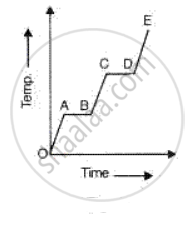
A substance is heated at a constant rate from a low temperature to a high temperature. A graph of temperature against time is shown in the figure. Which part or parts of the graph correspond(s) to the substance existing in two states?
Fill in the following blank using suitable word:
SI unit of heat is .........
Water boils at 120 °C in a pressure cooker. Explain the reason.
State the condition for the flow of heat energy from one body to another.
Write the approximate values of the specific latent heat of vaporization of steam.
Give two reasons as to why copper is preferred over other metals for making calorimeters.
A. hot solid of mass 60 g at 100°C is placed in 150 g of water at 20° C. The final steady temperature recorded is 25°C. Calculate the specific heat capacity of the solid. [Specific heat capacity of water = 4200 J kg-1 °C-1]
Derive an expression for finding out the specific heat capacity of a body (solid) from the readings of an experiment given below:
(i) Mass of empty calorimeter (with stirrer) = m1 gm
(ii) Mass of the metal piece = M gm
(iii) Mass of colorimeter and water = m2 gm
(iv) Initial temperature and water = t1°C
(v) Temperature of hot solid (metal piece) = t2 °C
(vi) Final temperature of the mixture = t°C
(vii) Specific heat of calorimeter = 0.4 J gm / °C
Solve the following problem.
What is the specific heat of metal if 50 cal of heat is needed to raise 6 kg of the metal from 20°C to 62 °C?
The molar specific heat of a gas at constant volume is 12307.69 J kg-1 K-1. If the ratio of the two specific heats is 1.65, calculate the difference between the two molar specific heats of gas.
How much heat energy is necessary to raise the temperature of 5 kg of water from 20°C to 100°C?
From the options given below the specific heat of _______ is maximum.
Explain how heat capacity of a solid can be determined by the method of mixture.
The cold object the hot object enclosed in one box of heat-resistant material.
- What changes will occur in the two objects when temperature flows from those objects?
- Which principle can show that the energy exchange takes place between two objects only when kept in isolated system?
_______ is defined as the amount of heat required to raise the temperature of 1kg of a substance by 1°C.
Heat is applied to a rigid diatomic gas at constant pressure. The ratio ΔQ : ΔU : ΔW is ______.
A piece of lead weighing 500 g gives out 1200 calories of heat when it is cooled from 100° C to 20° C. Find its specific heat.
The molar specific heat of an ideal gas at constant pressure and constant volume is 'Cp' and 'Cv' respectively. If 'R' is the universal gas constant and the ratio 'Cp' to 'Cv' is 'γ' then CV = ______.
Two metals A and B have specific heat capacities in the ratio 2:3. If they are supplied same amount of heat then
If the mass ratio of metal A and metal B is 3:5 then calculate the ratio in which their temperatures rise.
We would like to make a vessel whose volume does not change with temperature (take a hint from the problem above). We can use brass and iron `(β_(vbrass) = (6 xx 10^(–5))/K and β_(viron) = (3.55 xx 10^(–5))/K)` to create a volume of 100 cc. How do you think you can achieve this.
A 0.2 kg metal at 150°C is placed in a copper calorimeter (water equivalent 0.025 kg) with 150 cm³ water at 27°C. Final temperature is 40°C. Find the specific heat of the metal.
Which method is used to determine the specific heat capacity of both solids and liquids by mixing a substance of unknown specific heat with water?
