Advertisements
Advertisements
प्रश्न
A geyser heats water flowing at the rate of 3.0 litres per minute from 27 °C to 77 °C. If the geyser operates on a gas burner, what is the rate of consumption of the fuel if its heat of combustion is 4.0 × 10⁴ J/g?
Advertisements
उत्तर १
Water is flowing at a rate of 3.0 litre/min.
The geyser heats the water, raising the temperature from 27°C to 77°C.
Initial temperature, T1 = 27°C
Final temperature, T2 = 77°C
∴Rise in temperature, ΔT = T2 – T1
= 77 – 27= 50°C
Heat of combustion = 4 × 10⁴ J/g
Specific heat of water, c = 4.2 J g–1 °C–1
Mass of flowing water, m = 3.0 litre/min = 3000 g/min
Total heat used, ΔQ = mc ΔT
= 3000 × 4.2 × 50
= 6.3 × 10⁵ J/min
∴ Rate of consumption = `(6.3 xx 0^5)/(4xx10^4) = 15.75 "g/min"`
उत्तर २
Volume of water heated = 3.0 litre per minute Mass of water heated, m = 3000 g per minute Increase in temperature,
`triangle T = 77^@C - 27^@C =50^@C`
Specific heat of water, `c = 4.2 Jg^(-1) ""^@ C^(-1)`
Amount of heat used = `Q = mctriangleT`
or `Q = 3000 "gmin"^(-1) xx 4.2 Jg^(-1) ""^@C^(-1)xx50^@C`
`= 63 xx 10^4 J min^(-1)`
Rate of combustion of fuel = `(63xx10^4 J min^(-1))/(4.0xx10^4 Jg^(-1))` = 15.75 `"g min"^(-1)`
APPEARS IN
संबंधित प्रश्न
Differentiate between heat capacity and specific heat capacity.
What do you mean by the following statement?
The heat capacity of a body is 50 JK-1?
The S.I. unit of specific heat capacity is ______.
Name the radiations for which the green house gases are transparent ?
State the effect of enhancement of green house effect.
What impact will climate changes have on the crops of food?
State three ways to minimize the global warming.
Equal heat is given to two objects A and B of mass 1 g. Temperature of A increases by 3°C and B by 5°C. Which object has more specific heat? And by what factor?
What is the specific heat capacity of boiling water?
Indian style of cooling drinking water is to keep it in a pitcher having porous walls. Water comes to the outer surface very slowly and evaporates. Most of energy needed for evaporation is taken from the water itself and the water is cooled down. Assume that a pitcher contains 10 kg of water and 0.2 g of water comes out per second. Assuming no backward heat transfer from the atmosphere to the water, calculate the time in which the temperature decrease by 5°C. Specific heat capacity of water = 4200 J kg−1 °C−1 and latent heat of vaporization of water = 2.27 × 10⁶ J kg−1.
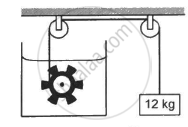
Figure shows a paddle wheel coupled to a mass of 12 kg through fixed frictionless pulleys. The paddle is immersed in a liquid of heat capacity 4200 J K−1 kept in an adiabatic container. Consider a time interval in which the 12 kg block falls slowly through 70 cm. (a) How much heat is given to the liquid? (b) How much work is done on the liquid? (c) Calculate the rise in the temperature of the liquid neglecting the heat capacity of the container and the paddle.
A solid of mass 80 g at 80°C is dropped in 400 g water at 10°C. If final temp. is 30°C, find the sp. heat cap. of the solid.
What are the factors on which the quantity of heat given to a body depends?
Explain, why water is considered as best liquid for quenching thirst?
Is it possible to condense the water formed, back to ice by adding ice at 0°C. Explain with reason.
Some heat is provided to a body to raise its temperature by 25°C. What will be the corresponding rise in temperature of the body as shown on the Kelvin scale?
A substance is in the form of a solid at 0°C. The amount of heat added to this substance and the temperature of the substance are plotted on the following graph:
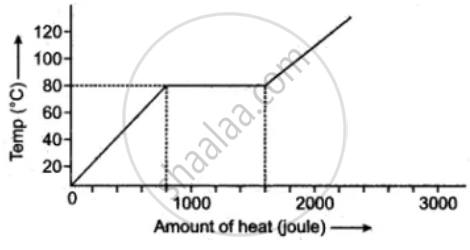
If the specific heat capacity of the solid substance is 500 J/kg °G, find from the graph, the mass of the substance.
Water falls from a height of 50 m. Calculate the rise in the temperature of water when it strikes the bottom.
(g = 10 ms-2; Specific heat capacity of water = 4200 J / kg°C)
Solve the following problem.
Specific latent heat of vaporization of water is 2.26 × 10⁶ J/kg. Calculate the energy needed to change 5.0 g of water into steam at 100 ºC.
From the options given below the specific heat of _______ is maximum.
Explain how heat capacity of a solid can be determined by the method of mixture.
What is specific heat capacity?
When a uniform rod is heated, which of the following quantity of the rod will increase
For a gas, `"R"/"C"_"v"=0.4`, where R Is universal gas constant and Cv is the molar specific heat at constant volume. The gas is made up of molecules, which are ______
Which of the following substances (A, B and C) has the highest specific beat?
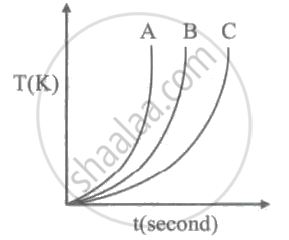
For a gas `"R"/"C"_"v" = 0.4,` where 'R' is the universal gas constant and 'Cv' is molar specific heat at constant volume. The gas is made up of molecules which are ______.
On supplying 100 µC of charge to a conductor, its potential rises by 5 V then capacity of the conductor is ______.
The diagram below shows a cooling curve for 200 g of water. The heat is extracted at the rate of 100 Js-1. Answer the questions that follow:
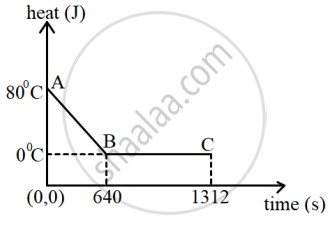
- Calculate specific heat capacity of water.
- Heat released in the region BC.
Two metals A and B have specific heat capacities in the ratio 2:3. If they are supplied same amount of heat then
If the mass ratio of metal A and metal B is 3:5 then calculate the ratio in which their temperatures rise.
Specific heat capacity C = ______.
J/Kg °C is the unit of specific heat capacity.
Match the following
| 1. | Specific heat capacity | a. | Dewar bottle |
| 2. | Calorimeter | b. | Lavoisier and Simon |
| 3. | Vacuum flask | c. | J Kg-1 K-1 |
| 4. | Ice – calorimeter | d. | Heat capacity |
What is the amount of heat required to raise the temperature of 5 kg of iron from 30°C to 130°C? Specific heat capacity of iron = 483 Jkg-1C-1.
We would like to make a vessel whose volume does not change with temperature (take a hint from the problem above). We can use brass and iron `(β_(vbrass) = (6 xx 10^(–5))/K and β_(viron) = (3.55 xx 10^(–5))/K)` to create a volume of 100 cc. How do you think you can achieve this.
To study energy exchange between hot and cold objects, the system of both objects is isolated from the environment by keeping them inside ______.
Which method is used to determine the specific heat capacity of both solids and liquids by mixing a substance of unknown specific heat with water?
