Advertisements
Advertisements
प्रश्न
A geyser heats water flowing at the rate of 3.0 litres per minute from 27 °C to 77 °C. If the geyser operates on a gas burner, what is the rate of consumption of the fuel if its heat of combustion is 4.0 × 10⁴ J/g?
Advertisements
उत्तर १
Water is flowing at a rate of 3.0 litre/min.
The geyser heats the water, raising the temperature from 27°C to 77°C.
Initial temperature, T1 = 27°C
Final temperature, T2 = 77°C
∴Rise in temperature, ΔT = T2 – T1
= 77 – 27= 50°C
Heat of combustion = 4 × 10⁴ J/g
Specific heat of water, c = 4.2 J g–1 °C–1
Mass of flowing water, m = 3.0 litre/min = 3000 g/min
Total heat used, ΔQ = mc ΔT
= 3000 × 4.2 × 50
= 6.3 × 10⁵ J/min
∴ Rate of consumption = `(6.3 xx 0^5)/(4xx10^4) = 15.75 "g/min"`
उत्तर २
Volume of water heated = 3.0 litre per minute Mass of water heated, m = 3000 g per minute Increase in temperature,
`triangle T = 77^@C - 27^@C =50^@C`
Specific heat of water, `c = 4.2 Jg^(-1) ""^@ C^(-1)`
Amount of heat used = `Q = mctriangleT`
or `Q = 3000 "gmin"^(-1) xx 4.2 Jg^(-1) ""^@C^(-1)xx50^@C`
`= 63 xx 10^4 J min^(-1)`
Rate of combustion of fuel = `(63xx10^4 J min^(-1))/(4.0xx10^4 Jg^(-1))` = 15.75 `"g min"^(-1)`
APPEARS IN
संबंधित प्रश्न
Calculate the mass of ice needed to cool 150 g of water contained in a calorimeter of mass 50 g at 32 °C such that the final temperature is 5 °C. Specific heat capacity of calorimeter = 0.4 J g-1 °C-1, Specific heat capacity of water = 4.2 J g-1°C-1, latent heat capacity of ice = 330 J g-1.
What do you understand by the following statements:
The heat capacity of the body is 60JK-1.
Water in lakes and ponds do not freeze at once in cold countries. Give a reason is support of your answer.
50 g of metal piece at 27°C requires 2400 J of heat energy so as to attain a temperature of 327°C . Calculate the specific heat capacity of the metal.
A liquid X has the maximum specific heat capacity and is used as a coolant in Car Radiators. Name the liquid X.
The temperature of 170 g of water at 50°C is lowered to 5°C by adding a certain amount of ice to it. Find the mass of ice added.
Given: Specific heat capacity of water = 4200 J kg-1 °C-1 and specific latent heat of ice = 336000 J kg-1.
Differentiate between heat capacity and specific heat capacity.
Write the approximate value of specific heat capacity of water in S.I. unit.
Explain the term boiling point ?
It is generally cold after a hail-storm then during and before the hail storm. Give reason.
State the impact of global warming on life on the earth.
Who shall pay carbon tax ?
Without green house effect, the average temperature of earth’s surface would have been:
(a) – 18℃
(b) 33℃
(c) 0℃
(d) 15℃
Equal heat is given to two objects A and B of mass 1 g. Temperature of A increases by 3°C and B by 5°C. Which object has more specific heat? And by what factor?
What is the specific heat capacity of boiling water?
Figure shows a paddle wheel coupled to a mass of 12 kg through fixed frictionless pulleys. The paddle is immersed in a liquid of heat capacity 4200 J K−1 kept in an adiabatic container. Consider a time interval in which the 12 kg block falls slowly through 70 cm. (a) How much heat is given to the liquid? (b) How much work is done on the liquid? (c) Calculate the rise in the temperature of the liquid neglecting the heat capacity of the container and the paddle.
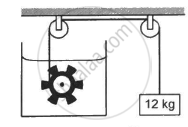
(i) State whether the specific heat capacity of a substance remains the same when its state changes from solid to liquid.
(ii) Give one example to support your answer.
What change in heat energy occurs when lead at its melting point
solidifies without change in the temperature?
Define heat capacity.
State, with reason, which of the two, boiling water or steam both at 100°C will produce more severe burns.
If 10125 J of heat energy boils off 4.5 g of water at 100°C to steam at 100°C, find the specific latent heat of steam.
What are other units of heat? Name and define them.
m kg of a substance of specific heat capacity s J/kg °C is heated so that its temperature rises from θ1°C to θ2°C. Write down the expression for the heat Q supplied.
If substances A and B are liquids then which one would be more useful in car radiators?
Given: Specific heat capacity’A’ 3.8 J/g /K. Specific heat capacity ‘B’ 0.4 J/g /K.
The heat capacity of the vessel of mass 100 kg is 8000 J/°K. Find its specific heat capacity.
The molar specific heat of an ideal gas at constant pressure and constant volume is 'Cp' and 'Cv' respectively. If 'R' is the universal gas constant and the ratio 'Cp' to 'Cv' is 'γ' then CV = ______.
J/Kg °C is the unit of specific heat capacity.
Match the following:
| Column A | Column B | ||
| 1. | Specific heat capacity of water | a. | 0°C |
| 2. | Latent heat of fusion of ice | b. | 2260 J/g |
| 3. | Latent heat of vaporization of water | c. | 100°C |
| 4. | The melting point of iced | d. | 4.2 J/g°C |
| 5. | The boiling point of water | e. | 336 J/g |
To study energy exchange between hot and cold objects, the system of both objects is isolated from the environment by keeping them inside ______.
A block of ice of mass 120 g at temperature 0°C is put in 300 gm of water at 25°C. The xg of ice melts as the temperature of the water reaches 0°C. The value of x is ______.
[Use: Specific heat capacity of water = 4200 Jkg-1K-1, Latent heat of ice = 3.5 × 10⁵ Jkg-1]
Prove the Mayer's relation `C_p - C _v = R/J`
Which method is used to determine the specific heat capacity of both solids and liquids by mixing a substance of unknown specific heat with water?
A mixture of one mole of monoatomic gas and one mole of a diatomic gas (rigid) are kept at room temperature (27°C). The ratio of specific heat of gases at constant volume respectively is:
