Advertisements
Advertisements
प्रश्न
Advertisements
उत्तर
Farmers fill their fields with water on a cold winter night to protect the crops from frost. In the absence of water, if on a cold night the temperature of the surroundings falls below 0°C, then the veins of the plants will freeze. Due to the anomalous expansion of water, ice will occupy more volume than water. As a result of this expansion, veins shall burst and crops will be destroyed. But water sprinkled on the crops shall not allow the temperature of the veins to fall below 0°C.
संबंधित प्रश्न
How will rise in sea level affect population in coastal countries?
The ratio of specific heat capacity to molar heat capacity of a body _____________ .
Indian style of cooling drinking water is to keep it in a pitcher having porous walls. Water comes to the outer surface very slowly and evaporates. Most of energy needed for evaporation is taken from the water itself and the water is cooled down. Assume that a pitcher contains 10 kg of water and 0.2 g of water comes out per second. Assuming no backward heat transfer from the atmosphere to the water, calculate the time in which the temperature decrease by 5°C. Specific heat capacity of water = 4200 J kg−1 °C−1 and latent heat of vaporization of water = 2.27 × 10⁶ J kg−1.
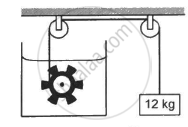
Figure shows a paddle wheel coupled to a mass of 12 kg through fixed frictionless pulleys. The paddle is immersed in a liquid of heat capacity 4200 J K−1 kept in an adiabatic container. Consider a time interval in which the 12 kg block falls slowly through 70 cm. (a) How much heat is given to the liquid? (b) How much work is done on the liquid? (c) Calculate the rise in the temperature of the liquid neglecting the heat capacity of the container and the paddle.
104g of water at 30°C is taken in a calorimeter made of copper of mass 42 g. When a certain mass of ice at 0°C is added to it, the final steady temperature of the mixture after the ice has melted, was found to be 10°C. Find the mass of ice added. [Specific heat capacity of water = 4.2 Jg–1°C–1 ; Specific latent heat of fusion of ice = 336 Jg–1; Specific heat capacity of copper = 0.4 Jg–1°C–1] .
Why is specific heat capacity taken as a measure of thermal inertia?
Express the change in internal energy in terms of molar specific heat capacity.
A monoatomic gas of pressure 'P' having volume 'V' expands isothermally to a volume '2V' and then adiabatically to a volume '16V'. The final pressure of the gas is ______.
(ratio of specific heats = `5/3`)
An office room contains about 4000 moles of air. The change in the internal energy of this much air when it is cooled from 34° C to 19° C at a constant pressure of 1.0 atm is (Use `gamma_"air"` = 1.4 and Universal gas constant = 8.314 J / mol K) ____________.
Give one example where high specific heat capacity of water is used as heat reservoir.
