Advertisements
Advertisements
प्रश्न
The ratio of specific heat capacity to molar heat capacity of a body _____________ .
विकल्प
is a universal constant
depends on the mass of the body
depends of the molecular weight of the body
is dimensionless
Advertisements
उत्तर
depends of the molecular weight of the body
Specific heat capacity of a body,
\[s = \frac{Q}{m\Delta\theta}\]
Here,
Q = Heat supplied
m = Mass of body
Δθ = Change in temperature
Molar heat capacity of a body,
\[C = \frac{Q}{n\Delta\theta}\]
Here,
Q = Heat supplied
n = Number of moles
Δθ = Change in temperature
∴ The ratio of the specific heat capacity and molar heat capacity is given by
\[\frac{s}{C} = \frac{\frac{Q}{m\Delta\theta}}{\frac{Q}{n\Delta\theta}} = \frac{n}{m} = \frac{n}{nM} = \frac{1}{M}\]
Here,
M = Molar mass related to number of moles
m = Mass
As the value of M is different for different bodies of different composition, the ratio cannot be a universal constant.
Also, the ratio is independent of the mass of the body.
The ratio of the specific heat and molar heat capacity depends on the molecular weight of the body.
Clearly, the unit of molecular weight is kg/mole. So, the ratio that depends only on the molecular weight cannot be dimensionless.
APPEARS IN
संबंधित प्रश्न
Given below are observations on molar specific heats at room temperature of some common gases.
| Gas |
Molar specific heat (Cv) (cal mol–1 K–1) |
| Hydrogen | 4.87 |
| Nitrogen | 4.97 |
| Oxygen | 5.02 |
| Nitric oxide | 4.99 |
| Carbon monoxide | 5.01 |
| Chlorine | 6.17 |
The measured molar specific heats of these gases are markedly different from those for monatomic gases. Typically, molar specific heat of a monatomic gas is 2.92 cal/mol K. Explain this difference. What can you infer from the somewhat larger (than the rest) value for chlorine?
Define heat capacity and state its SI unit.
What do you understand by the following statements:
The heat capacity of the body is 60JK-1.
A liquid X has the maximum specific heat capacity and is used as a coolant in Car Radiators. Name the liquid X.
Give a mathematical relation between Heat Capacity and Specific Heat Capacity.
Differentiate between heat capacity and specific heat capacity.
Write the approximate value of specific heat capacity of water in S.I. unit.
Why do the farmers fill their fields with water on a cold winter night?
Water is used in hot water bottles for fomentation. Give a reason.
A heater of power P watt raises the temperature of m kg of a liquid by Δt K in time t s. Express
the specific heat capacity of liquid in terms of above data.
The specific heat capacity of water is :
Find the time taken by a 500 W heater to raise the temperature of 50 kg of material of specific heat capacity 960 J kg-1K-1, from 18°C to 38° C. Assume that all the heat energy supplied by the heater is given to the material.
An electric heater of power 600 W raises the temperature of 4.0 kg of a liquid from 10.0℃ to 15.0℃ in100 s. Calculate:
- the heat capacity of 4.0 kg of liquid,
- the specific heat capacity of the liquid.
Explain the term boiling point ?
Explain the meaning of green house effect.
Study the following procedure and answer the questions below:
1. Take 3 spheres of iron, copper and lead of equal mass.
2. Put all the 3 spheres in boiling water in a beaker for some time.
3. Take 3 spheres out of the water. Put them immediately on a thick slab of wax.
4. Note, the depth that each sphere goes into the wax.
i) Which property of substance can be studied with this procedure?
ii) Describe that property in minimum words.
iii) Explain the rule of heat exchange with this property.
Define the term 'specific heat capacity' and state its unit.
Define heat capacity.
Water boils at 120 °C in a pressure cooker. Explain the reason.
What is heat? What is the S. I. unit of heat?
State the condition for the flow of heat energy from one body to another.
Write the approximate values of the specific latent heat of fusion of ice.
Why is specific heat capacity taken as a measure of thermal inertia?
Solve the following problem.
Specific latent heat of vaporization of water is 2.26 × 10⁶ J/kg. Calculate the energy needed to change 5.0 g of water into steam at 100 ºC.
The cold object the hot object enclosed in one box of heat-resistant material.
- What changes will occur in the two objects when temperature flows from those objects?
- Which principle can show that the energy exchange takes place between two objects only when kept in isolated system?
_______ is defined as the amount of heat required to raise the temperature of 1kg of a substance by 1°C.
The heat capacity of the vessel of mass 100 kg is 8000 J/°K. Find its specific heat capacity.
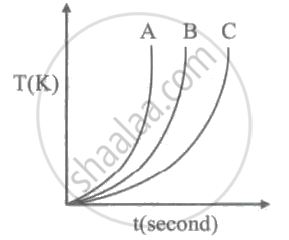
Which of the following substances (A, B and C) has the highest specific beat?
At same temperature and pressure of an ideal gas, ____________.
If 'f' is the number of degrees of freedom of a molecule of a gas and ratio of molar specific heats of a gas, ϒ = 1 + `2/"f"` where ϒ = Cp/Cv. The ratio of 'ϒ' for monoatomic gas to 'ϒ' for (rigid) f diatomic gas is ______.
The specific heat capacity of water is ______.
Two cylinders of equal height and radius are made of copper and aluminum. Which of them conducts heat faster?
Match the following:
| Column A | Column B | ||
| 1. | Specific heat capacity of water | a. | 0°C |
| 2. | Latent heat of fusion of ice | b. | 2260 J/g |
| 3. | Latent heat of vaporization of water | c. | 100°C |
| 4. | The melting point of iced | d. | 4.2 J/g°C |
| 5. | The boiling point of water | e. | 336 J/g |
The molar specific heats of an ideal gas at constant pressure and volume are denoted by Cp and Cv, respectively. If `gamma = "C"_"p"/"C"_"v"` and R is the universal gas constant, then Cv is equal to ______.
Prove the Mayer's relation `C_p - C _v = R/J`
Give one example where high specific heat capacity of water is used as heat reservoir.
