Advertisements
Advertisements
प्रश्न
50 g of metal piece at 27°C requires 2400 J of heat energy so as to attain a temperature of 327°C . Calculate the specific heat capacity of the metal.
Advertisements
उत्तर
m = 50 g or `50/1000` kg
H = 2400 J
Q1 = 27 °C
Q2 = 327 °C
H = mcθ
c = `"H"/("m"theta)`
`= 2400/(50/1000 xx (327 - 27))`
`= 2400/(5/100 xx 300)`
`= 2400/15 = 160` J/Kg - K
APPEARS IN
संबंधित प्रश्न
What do you understand by the following statements:
The heat capacity of the body is 60JK-1.
State two factors upon which the heat absorbed by a body depends
What are the factors on which the quantity of heat given to a body depends?
Explain, Why is it advisabile to pour cold water over burns, caused on human body, by hot solids?
Solve the following problem.
What is the specific heat of metal if 50 cal of heat is needed to raise 6 kg of the metal from 20°C to 62 °C?
Numerical Problem.
What could be the final temperature of a mixture of 100 g of water at 90 °C and 600g of water at 20°C.
When a uniform rod is heated, which of the following quantity of the rod will increase
Which of the following substances (A, B and C) has the highest specific beat?
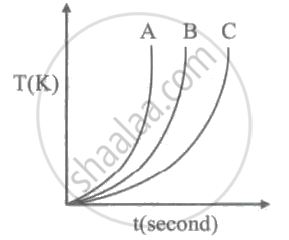
Which of the substances P, Q, or R has the lowest specific heat? The temperature v/s time graph is shown ______.

A piece of lead weighing 500 g gives out 1200 calories of heat when it is cooled from 100° C to 20° C. Find its specific heat.
