Advertisements
Advertisements
प्रश्न
Advertisements
उत्तर
Latent heat of fusion of ice, L=336 J/g
Mass of ice, m=2g
Amount of heat required convert 2g of ice at 0°C into water at 0°C
= m x L
= 2 x 336 = 672 J
APPEARS IN
संबंधित प्रश्न
45 g of water at 50°C in a beaker is cooled when 50 g of copper at 18° C is added to it. The contents are stirred till a final constant temperature is reached. Calculate this final temperature. The specific heat capacity of copper is 0.39 J g-1K-1 and that of water is 4.2 J g-1K-1. State the assumption used.
What impact will climate changes have on the crops of food?
What change in heat energy occurs when lead at its melting point
solidifies without change in the temperature?
Specific heat capacity of substance A is 3.8 J g-1 K-1whereas the specific heat capacity of substance B is 0.4 J g-1 K-1. Which of the two is a good conductor of heat? How is one led to this conclusion?
Derive an expression for finding out the specific heat capacity of a body (solid) from the readings of an experiment given below:
(i) Mass of empty calorimeter (with stirrer) = m1 gm
(ii) Mass of the metal piece = M gm
(iii) Mass of colorimeter and water = m2 gm
(iv) Initial temperature and water = t1°C
(v) Temperature of hot solid (metal piece) = t2 °C
(vi) Final temperature of the mixture = t°C
(vii) Specific heat of calorimeter = 0.4 J gm / °C
What is specific heat capacity?
Which of the following substances (A, B and C) has the highest specific beat?
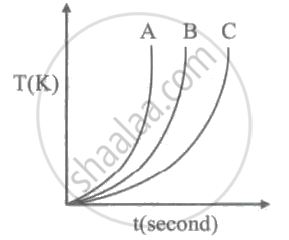
Match the columns:
| Column ‘A’ | Column ‘B’ |
| The SI unit of specific heat capacity | (a) Jkg−1°C−1 |
| (b) kg/m3 | |
| (c) calorie |
Prove the Mayer's relation `C_p - C _v = R/J`
