Advertisements
Advertisements
प्रश्न
Two metallic blocks P and Q of masses in ratio 2: 1 are given the same amount of heat. If their temperature rise by the same amount, compare their specific heat capacities.
Advertisements
उत्तर
Let CP and Cq be the specific heat capacities of blocks P and Q respectively,
We know that,
`Q/(m xx Δt)`
`∴ (C_p/C_q) = ((Q / (2m xxΔt))/(Q / (m xx ΔT)) ) = 1/2`
Hence, the required ratio is 1: 2.
APPEARS IN
संबंधित प्रश्न
A child running a temperature of 101°F is given an antipyrin (i.e. a medicine that lowers fever) which causes an increase in the rate of evaporation of sweat from his body. If the fever is brought down to 98 °F in 20 min, what is the average rate of extra evaporation caused, by the drug? Assume the evaporation mechanism to be the only way by which heat is lost. The mass of the child is 30 kg. The specific heat of human body is approximately the same as that of water, and latent heat of evaporation of water at that temperature is about 580 cal g–1.
Water in lakes and ponds do not freeze at once in cold countries. Give a reason is support of your answer.
Name three fossil fuels that emit carbon dioxide into the atmosphere ?
State the impact of global warming on life on the earth.
Does the specific heat capacity of a substance depend upon its mass and rise in temperature only?
Calculate the amount of heat released when 5.0 g of water at 20°C is changed into ice at 0°C.
(Specific heat capacity of water = 4.2 J/g°C
Specific latent heat of fusion of ice = 336 J/g)
Numerical Problem.
How much heat energy is required to change 2 kg of ice at 0°C into water at 20°C? (Specific latent heat of fusion of water = 3,34,000 J/kg, Specific heat capacity of water = 4200 JKg–1K–1).
The diagram below shows a cooling curve for 200 g of water. The heat is extracted at the rate of 100 Js-1. Answer the questions that follow:
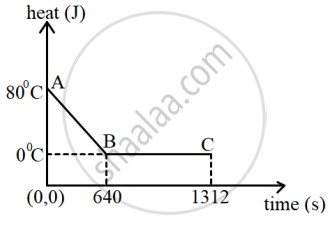
- Calculate specific heat capacity of water.
- Heat released in the region BC.
Prove the Mayer's relation `C_p - C _v = R/J`
