Advertisements
Advertisements
प्रश्न
Write a short note.
Specific heat capacity
Write a short note.
Specific capacity
Advertisements
उत्तर
- The amount of heat energy required to raise the temperature of a unit mass of an object by 1°C is called the specific heat or specific heat capacity of that object.
- SI unit of specific heat capacity is J/kg °C and CGS unit is cal/g °C
- It is denoted by ‘c’ and given by formula: c = `"Q"/("m"Delta "T")`
- Specific heat is a property of a substance and is different for different substances.
- Higher the value of specific heat capacity of the substance, higher is the amount of heat energy required to raise its temperature by 1 °C.
- The specific heat capacity of object is measured using principle of heat exchange.
संबंधित प्रश्न
Two metallic blocks P and Q of masses in ratio 2: 1 are given the same amount of heat. If their temperature rise by the same amount, compare their specific heat capacities.
Describe a method to determine the specific heat capacity of a solid, like a piece of copper ?
Name two green house gases ?
State the effect of enhancement of green house effect.
What is meant by global warming?
Without green house effect, the average temperature of earth’s surface would have been:
(a) – 18℃
(b) 33℃
(c) 0℃
(d) 15℃
Define the term 'specific heat capacity' and state its unit.
Name the substance which has maximum specific heat capacity.
Write two advantages of high specific heat capacity of water.
63.2 g of copper at 50°C can just melt 3.8g of ice. If the specific latent heat of ice is 336 J/g, find the specific heat capacity of copper.
How much heat energy is released when 5 g of water at 20° C changes to ice at 0° C?
[Specific heat capacity of water = 4.2 J g-1 ° C-1 Specific latent heat of fusion of ice = 336 J g-1]
Calculate the amount of heat released when 5.0 g of water at 20°C is changed into ice at 0°C.
(Specific heat capacity of water = 4.2 J/g°C
Specific latent heat of fusion of ice = 336 J/g)
Answer the following question.
Why do we generally consider two specific heats of a gas?
Which of the following substances (A, B and C) has the highest specific beat?
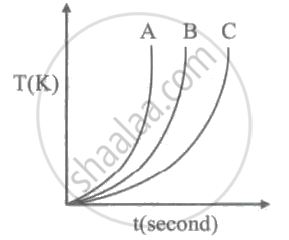
Heat is applied to a rigid diatomic gas at constant pressure. The ratio ΔQ : ΔU : ΔW is ______.
On supplying 100 µC of charge to a conductor, its potential rises by 5 V then capacity of the conductor is ______.
Why is water used as a coolant in radiators of a car?
We would like to make a vessel whose volume does not change with temperature (take a hint from the problem above). We can use brass and iron `(β_(vbrass) = (6 xx 10^(–5))/K and β_(viron) = (3.55 xx 10^(–5))/K)` to create a volume of 100 cc. How do you think you can achieve this.
