Advertisements
Advertisements
प्रश्न
If, in a central heating system, steam enters a radiation pipe at 100°C and water leaves the radiation pipe at 100°C, can this radiation pipe heat a room? Give an explanation for your answer.
Advertisements
उत्तर
Yes, because steam at 100°C gives out its latent heat of vaporisation to condense to water ut the same temperature of 100°C.
संबंधित प्रश्न
A refrigerator converts 100 g of water at 20°C to ice at -10°C in 35 minutes. Calculate the average rate of heat extraction in terms of watts.
Given: Specific heat capacity of ice = 2.1 J g-1°C-1
Specific heat capacity of water = 4.2 J g-1°C-1
Specific latent heat of fusion of ice = 336 J g-1
Who shall pay carbon tax ?
A solid of mass 80 g at 80°C is dropped in 400 g water at 10°C. If final temp. is 30°C, find the sp. heat cap. of the solid.
If 10125 J of heat energy boils off 4.5 g of water at 100°C to steam at 100°C, find the specific latent heat of steam.
An electric immersion heater is rated 1250 W. Calculate the time in which it will heat 20 kg of water at 5°C to 65°C.
How much heat energy is necessary to raise the temperature of 5 kg of water from 20°C to 100°C?
Which of the following substances (A, B and C) has the highest specific beat?
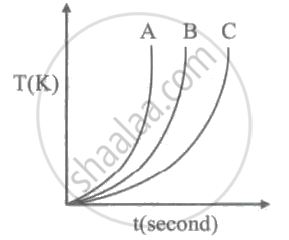
Water has the lowest specific heat capacity.
The molar specific heats of an ideal gas at constant pressure and volume are denoted by Cp and Cv, respectively. If `gamma = "C"_"p"/"C"_"v"` and R is the universal gas constant, then Cv is equal to ______.
Two blocks P and Q of different metals having their mass in the ratio 2 : 1 are given same amount of heat. Their temperature rises by same amount. Compare their specific heat capacities.
