Advertisements
Advertisements
प्रश्न
An equal quantity of heat is supplied to two substances A and B. The substance A shows a greater rise in temperature. What can you say about the heat capacity of A as compared to that of B?
Advertisements
उत्तर
Heat capacity of substance B is more than substance A.
संबंधित प्रश्न
A copper vessel of mass 100 g contains 150 g of water at 50°C. How much ice is needed to cool it to 5°C?
Given: Specific heat capacity of copper = 0.4 Jg-1 °C-1
The Specific heat capacity of water = 4.2 Jg-1 °C-1
The Specific latent heat of fusion ice = 336 Jg-1
Explain the term boiling point ?
Who shall pay carbon tax ?
Explain, why do sandy soils, get heated up quickly as compared to wet soils?
From the options given below the specific heat of _______ is maximum.
Derive Meyer’s relation for an ideal gas.
Two metals A and B have specific heat capacities in the ratio 2:3. If they are supplied same amount of heat then
If specific heat capacity of metal A is 0.26 Jg-1 0C-1 then calculate the specific heat capacity of metal B.
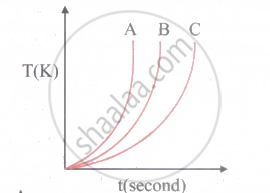
Which of the following substances (A, B and C) has the highest specific heat?
When two kilocalories of heat are supplied to a system, the internal energy of the system increases by 5030 J and the work done by the gas against the external pressure is 3350 J. Calculate J, the mechanical equivalent of heat.
Thermal capacities of substances A and B are same. If mass of A is more than mass of B then:
Which substance will have more specific heat capacity?
