Advertisements
Advertisements
प्रश्न
How will you prove experimentally that different substances have different specific heat capacities?
Advertisements
उत्तर
Experiment to prove different substances have different specific heat capacities:

- Take three balls of iron, copper, and lead of equal mass and put them in boiling water for some time. Then, take them out of the water and measure their temperature.
- All of them will be at temperature 100oC. Now, put them immediately on the thick slab of wax. Note the depth that each of the balls goes into the wax. The ball which absorbs more heat from the water will give more heat to wax. More wax will thus melt and the ball will go deeper into the wax. It will be observed that the iron ball goes deepest into the wax. The lead ball goes the least and the copper ball goes to intermediate depth. This shows that for the equal rise in temperature, the three balls have absorbed different amounts of heat.
- This means that the property which determines the amount of heat absorbed by a ball is different for the three balls. This property is called the specific heat capacity.
APPEARS IN
संबंधित प्रश्न
A geyser heats water flowing at the rate of 3.0 litres per minute from 27 °C to 77 °C. If the geyser operates on a gas burner, what is the rate of consumption of the fuel if its heat of combustion is 4.0 × 10⁴ J/g?
Discuss the role of high specific heat capacity of water with reference to climate in coastal areas.
How will climate changes affect the various animal species?
What is carbon tax?
Who shall pay carbon tax ?
Water boils at 120 °C in a pressure cooker. Explain the reason.
The farmers fill their fields with water in winter. Give reason.
If substances A and B are liquids then which one would be more useful in car radiators?
Given: Specific heat capacity’A’ 3.8 J/g /K. Specific heat capacity ‘B’ 0.4 J/g /K.
How much heat energy is released when 5 g of water at 20° C changes to ice at 0° C?
[Specific heat capacity of water = 4.2 J g-1 ° C-1 Specific latent heat of fusion of ice = 336 J g-1]
A. hot solid of mass 60 g at 100°C is placed in 150 g of water at 20° C. The final steady temperature recorded is 25°C. Calculate the specific heat capacity of the solid. [Specific heat capacity of water = 4200 J kg-1 °C-1]
Derive an expression for finding out the specific heat capacity of a body (solid) from the readings of an experiment given below:
(i) Mass of empty calorimeter (with stirrer) = m1 gm
(ii) Mass of the metal piece = M gm
(iii) Mass of colorimeter and water = m2 gm
(iv) Initial temperature and water = t1°C
(v) Temperature of hot solid (metal piece) = t2 °C
(vi) Final temperature of the mixture = t°C
(vii) Specific heat of calorimeter = 0.4 J gm / °C
Write a short note.
Specific heat capacity
Numerical Problem.
What is the heat in joules required to raise the temperature of 25 grams of water from 0°C to 100°C? What is the heat in Calories? (Specific heat of water = `(4.18"J")/("g"°"C")`
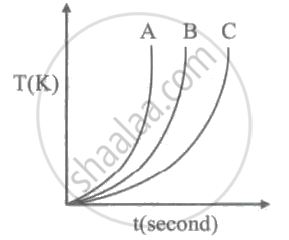
Which of the following substances (A, B and C) has the highest specific beat?
The ratio of the specific heats `c_"p"/c_"v"=gamma` in terms of degrees of freedom 'n' is given by ______.
A metal ball of heat capacity 50J/°C loses 2000 J of heat. By how much will its temperature fall?
