Advertisements
Advertisements
प्रश्न
Calculate the stress developed inside a tooth cavity filled with copper when hot tea at temperature of 57°C is drunk. You can take body (tooth) temperature to be 37°C and α = 1.7 × 10⁻⁵/°C, bulk modulus for copper = 140 × 109 N/m2.
Advertisements
उत्तर
According to the problem, decrease in temperature
(Δt) = 57 – 37 = 20°C
Coefficient of linear expansion
(α) = 1.7 × 10⁻⁵/°C
Bulk modulus for copper (B) = 140 × 109 N/m2
Coefficient of cubical expansion
(γ) = 3α = 5.1 × 10⁻⁵/°C
Let the initial volume of the cavity be V and its volume increases by ΔV due to increasing in temperature.
∴ `ΔV = γVΔt`
⇒ `(ΔV)/V = γΔt`
We know, B = `"Stress"/"Volume strain"`
∴ Thermal stress = `B xx ((ΔV)/V) = B(γΔT)`
= `B(3αΔT)` .....(∵ γ = 3α)
= 140 × 109 × 3 × 1.7 × 10–5 × 20
= 1.428 × 10⁸ Nm–2
This is about 103 times of atmospheric pressure.
APPEARS IN
संबंधित प्रश्न
A steel tape 1m long is correctly calibrated for a temperature of 27.0 °C. The length of a steel rod measured by this tape is found to be 63.0 cm on a hot day when the temperature is 45.0 °C. What is the actual length of the steel rod on that day? What is the length of the same steel rod on a day when the temperature is 27.0 °C? Coefficient of linear expansion of steel = 1.20 × 10⁻⁵ K–1
If two bodies are in thermal equilibrium in one frame, will they be in thermal equilibrium in all frames?
For a constant-volume gas thermometer, one should fill the gas at
A gas thermometer measures the temperature from the variation of pressure of a sample of gas. If the pressure measured at the melting point of lead is 2.20 times the pressure measured at the triple point of water, find the melting point of lead.
The density of water at 0°C is 0.998 g cm–3 and at 4°C is 1.000 g cm–1. Calculate the average coefficient of volume expansion of water in the temperature range of 0 to 4°C.
Show that the moment of inertia of a solid body of any shape changes with temperature as I = I0 (1 + 2αθ), where I0 is the moment of inertia at 0°C and α is the coefficient of linear expansion of the solid.
Answer the following question.
What is thermal stress?
Solve the following problem.
In olden days, while laying the rails for trains, small gaps used to be left between the rail sections to allow for thermal expansion. Suppose the rails are laid at room temperature 27 °C. If maximum temperature in the region is 45 °C and the length of each rail section is 10 m, what should be the gap left given that α = 1.2 × 10⁻⁵K–1 for the material of the rail section?
A metre scale made of a metal reads accurately at 25 °C. Suppose in an experiment an accuracy of 0.12 mm in 1 m is required, the range of temperature in which the experiment can be performed with this metre scale is ______.(coefficient of linear expansion of the metal is `20 xx 10^-6 / (°"C")`
A metal rod is heated to t°C. A metal rod has length, area of cross-section, Young's modulus and coefficient of linear expansion as 'L', 'A', 'Y' and 'a' respectively. When the rod is heated, the work performed is ______.
A metal rod of Young's moduls 'Y' and coefficient of linear expansion 'a' has its temeprature raised by 'Δ θ'. The linear stress to prevent the expansion of rod is ______.
(L and l is original length of rod and expansion respectively)
A metal rod of length Land cross-sectional area A is heated through T °C. What is the force required to prevent the expansion of the rod lengthwise?
(Y = Young's modulus of material of the rod, α = coefficient of linear expansion of the rod.)
An aluminium sphere is dipped into water. Which of the following is true?
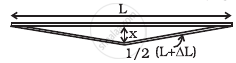
A rail track made of steel having length 10 m is clamped on a raillway line at its two ends (figure). On a summer day due to rise in temperature by 20° C, it is deformed as shown in figure. Find x (displacement of the centre) if αsteel = 1.2 × 10⁻⁵/°C.
An anisotropic material has coefficient of linear thermal expansion α1, α2 and α3 along x, y and z-axis respectively. Coefficient of cubical expansion of its material will be equal to ______.
A clock with an iron pendulum keeps the correct time at 15°C. If the room temperature is 20°C, the error in seconds per day will be near ______.
(coefficient of linear expansion of iron is 1.2 × 10⁻⁵/°C)
When heat is given to a substance, it generally ______.
Among solids, liquids, and gases, the thermal expansion on heating is ______.
