Advertisements
Advertisements
प्रश्न
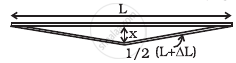
A rail track made of steel having length 10 m is clamped on a raillway line at its two ends (figure). On a summer day due to rise in temperature by 20° C, it is deformed as shown in figure. Find x (displacement of the centre) if αsteel = 1.2 × 10⁻⁵/°C.
Advertisements
उत्तर
Consider the diagram

Applying Pythagoras theorem in the right-angled triangle in figure
`((L + ΔL)/2)^2 = (L/2)^2 + x^2`
⇒ `x = sqrt(((L + ΔL)/2)^2 = (L/2)^2)`
= `1/2 sqrt((L + ΔL)^2 - L^2)`
= `1/2 sqrt((L^2 + ΔL^2 + 2LΔL) - L^2)`
= `1/2 sqrt((ΔL^2 + 2LΔL)`
As increase in length ΔL is very small, therefore, neglecting (ΔL)2, we get
`x = 1/2 xx sqrt(2LΔL)` ......(i)
But ΔL = LαΔt ......(ii)
Substituting the value of ΔL in equation (i) from equation (ii)
`x = 1/2 sqrt(2L xx LαΔt)`
= `1/2 L sqrt(2αΔt)`
= `10/2 xx sqrt(2 xx 1.2 xx 10^-5 xx 20)`
= `5 xx sqrt(4 xx 1.2 xx 10^-4)`
= `5 xx 2 xx 1.1 xx 10^-2`
= 0.11
= 11 cm
APPEARS IN
संबंधित प्रश्न
A steel tape 1m long is correctly calibrated for a temperature of 27.0 °C. The length of a steel rod measured by this tape is found to be 63.0 cm on a hot day when the temperature is 45.0 °C. What is the actual length of the steel rod on that day? What is the length of the same steel rod on a day when the temperature is 27.0 °C? Coefficient of linear expansion of steel = 1.20 × 10⁻⁵ K–1
A hole is drilled in a copper sheet. The diameter of the hole is 4.24 cm at 27.0 °C. What is the change in the diameter of the hole when the sheet is heated to 227 °C? Coefficient of linear expansion of copper = 1.70 × 10⁻⁵ K–1.
A brass rod of length 50 cm and diameter 3.0 mm is joined to a steel rod of the same length and diameter. What is the change in length of the combined rod at 250 °C, if the original lengths are at 40.0 °C? Is there a ‘thermal stress’ developed at the junction? The ends of the rod are free to expand (Co-efficient of linear expansion of brass = 2.0 × 10⁻⁵ K–1, steel = 1.2 × 10⁻⁵ K–1).
If mercury and glass had equal coefficients of volume expansion, could we make a mercury thermometer in a glass tube?
A gas thermometer measures the temperature from the variation of pressure of a sample of gas. If the pressure measured at the melting point of lead is 2.20 times the pressure measured at the triple point of water, find the melting point of lead.
Answer the following question.
Derive the relation between three coefficients of thermal expansion.
Answer the following question.
State applications of thermal expansion.
Answer the following question.
What is thermal stress?
An iron plate has a circular hole of a diameter 11 cm. Find the diameter of the hole when the plate is uniformly heated from 10° C to 90° C.`[alpha = 12 xx 10^-6//°"C"]`
A metre scale made of a metal reads accurately at 25 °C. Suppose in an experiment an accuracy of 0.12 mm in 1 m is required, the range of temperature in which the experiment can be performed with this metre scale is ______.(coefficient of linear expansion of the metal is `20 xx 10^-6 / (°"C")`
A metal sphere 10.01 cm in diameter is placed on a brass ring of internal diameter 10 cm and at the same temperature of 12° C. The temperature up to which they should be heated together so that the metal sphere just passes through the ring is `[alpha_"metal"= 12 xx 10^-6//°"C" and alpha_"brass" =18 xx 10^-6//°"C"]` ____________.
The volume of a metal block changes by 0.86% when heated through 200 °C then its coefficient of cubical expansion is ______.
An aluminium sphere is dipped into water. Which of the following is true?
Find out the increase in moment of inertia I of a uniform rod (coefficient of linear expansion α) about its perpendicular bisector when its temperature is slightly increased by ∆T.
Each side of a box made of metal sheet in cubic shape is 'a' at room temperature 'T', the coefficient of linear expansion of the metal sheet is 'α'. The metal sheet is heated uniformly, by a small temperature ΔT, so that its new temeprature is T + ΔT. Calculate the increase in the volume of the metal box.
An anisotropic material has coefficient of linear thermal expansion α1, α2 and α3 along x, y and z-axis respectively. Coefficient of cubical expansion of its material will be equal to ______.
A clock with an iron pendulum keeps the correct time at 15°C. If the room temperature is 20°C, the error in seconds per day will be near ______.
(coefficient of linear expansion of iron is 1.2 × 10⁻⁵/°C)
The increase in the dimensions of a body due to an increase in its temperature is called ______.
Among solids, liquids, and gases, the thermal expansion on heating is ______.
