Advertisements
Advertisements
प्रश्न
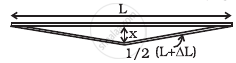
A rail track made of steel having length 10 m is clamped on a raillway line at its two ends (figure). On a summer day due to rise in temperature by 20° C, it is deformed as shown in figure. Find x (displacement of the centre) if αsteel = 1.2 × 10⁻⁵/°C.
Advertisements
उत्तर
Consider the diagram

Applying Pythagoras theorem in the right-angled triangle in figure
`((L + ΔL)/2)^2 = (L/2)^2 + x^2`
⇒ `x = sqrt(((L + ΔL)/2)^2 = (L/2)^2)`
= `1/2 sqrt((L + ΔL)^2 - L^2)`
= `1/2 sqrt((L^2 + ΔL^2 + 2LΔL) - L^2)`
= `1/2 sqrt((ΔL^2 + 2LΔL)`
As increase in length ΔL is very small, therefore, neglecting (ΔL)2, we get
`x = 1/2 xx sqrt(2LΔL)` ......(i)
But ΔL = LαΔt ......(ii)
Substituting the value of ΔL in equation (i) from equation (ii)
`x = 1/2 sqrt(2L xx LαΔt)`
= `1/2 L sqrt(2αΔt)`
= `10/2 xx sqrt(2 xx 1.2 xx 10^-5 xx 20)`
= `5 xx sqrt(4 xx 1.2 xx 10^-4)`
= `5 xx 2 xx 1.1 xx 10^-2`
= 0.11
= 11 cm
APPEARS IN
संबंधित प्रश्न
A hole is drilled in a copper sheet. The diameter of the hole is 4.24 cm at 27.0 °C. What is the change in the diameter of the hole when the sheet is heated to 227 °C? Coefficient of linear expansion of copper = 1.70 × 10⁻⁵ K–1.
The coefficient of volume expansion of glycerin is 49 × 10–5 K–1. What is the fractional change in its density for a 30 °C rise in temperature?
A 10 kW drilling machine is used to drill a bore in a small aluminium block of mass 8.0 kg. How much is the rise in temperature of the block in 2.5 minutes, assuming 50% of power is used up in heating the machine itself or lost to the surroundings Specific heat of aluminium = 0.91 J g–1 K–1
If mercury and glass had equal coefficients of volume expansion, could we make a mercury thermometer in a glass tube?
A system X is neither in thermal equilibrium with Y nor with Z. The systems Y and Z
Answer the following question.
Give an example of the disadvantages of thermal stress in practical use?
Solve the following problem.
In olden days, while laying the rails for trains, small gaps used to be left between the rail sections to allow for thermal expansion. Suppose the rails are laid at room temperature 27 °C. If maximum temperature in the region is 45 °C and the length of each rail section is 10 m, what should be the gap left given that α = 1.2 × 10⁻⁵K–1 for the material of the rail section?
A metal sphere 10.01 cm in diameter is placed on a brass ring of internal diameter 10 cm and at the same temperature of 12° C. The temperature up to which they should be heated together so that the metal sphere just passes through the ring is `[alpha_"metal"= 12 xx 10^-6//°"C" and alpha_"brass" =18 xx 10^-6//°"C"]` ____________.
A student records the initial length l, change in temperature ∆T and change in length ∆l of a rod as follows:
| S.No. | l(m) | ∆T (C) | ∆l (m) |
| 1. | 2 | 10 | `4 xx 10^-4` |
| 2. | 1 | 10 | `4 xx 10^-4` |
| 3. | 2 | 20 | `2 xx 10^-4` |
| 4. | 3 | 10 | `6 xx 10^-4` |
If the first observation is correct, what can you say about observations 2, 3 and 4.
Find out the increase in moment of inertia I of a uniform rod (coefficient of linear expansion α) about its perpendicular bisector when its temperature is slightly increased by ∆T.
At what temperature a gold ring of diameter 6.230 cm be heated so that it can be fitted on a wooden bangle of diameter 6.241 cm? Both diameters have been measured at room temperature (27°C). (Given: coefficient of linear thermal expansion of gold αL = 1.4 × 10⁻⁵ K-1).
Each side of a box made of metal sheet in cubic shape is 'a' at room temperature 'T', the coefficient of linear expansion of the metal sheet is 'α'. The metal sheet is heated uniformly, by a small temperature ΔT, so that its new temeprature is T + ΔT. Calculate the increase in the volume of the metal box.
The height of mercury column measured with brass scale at temperature T0 is H0. What height H' will the mercury column have at T = 0°C. Coefficient of volume expansion of mercury is γ. Coefficient of linear expansion of brass is α ______.
An anisotropic material has coefficient of linear thermal expansion α1, α2 and α3 along x, y and z-axis respectively. Coefficient of cubical expansion of its material will be equal to ______.
Length of steel rod so that it is 5 cm longer than the copper rod at all temperatures should be ______ cm.
(α for copper = 1.7 × 10⁻⁵/°C and α for steel = 1.1 × 10⁻⁵/°C)
A glass flask is filled up to a mark with 50 cc of mercury at 18°C. If the flask and contents are heated to 38°C, how much mercury will be above the mark? (α for glass is 9 × 10⁻⁶/°C and coefficient of real expansion of mercury is 180 × 10-6/°C)
The increase in the dimensions of a body due to an increase in its temperature is called ______.
The volume of a block of metal at 30°C changes by 0.12% when its temperature is increased to 70°C. The coefficient of linear expansion of the metal is ______.
