Advertisements
Advertisements
Question
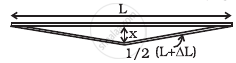
A rail track made of steel having length 10 m is clamped on a raillway line at its two ends (figure). On a summer day due to rise in temperature by 20° C, it is deformed as shown in figure. Find x (displacement of the centre) if αsteel = 1.2 × 10⁻⁵/°C.
Advertisements
Solution
Consider the diagram

Applying Pythagoras theorem in the right-angled triangle in figure
`((L + ΔL)/2)^2 = (L/2)^2 + x^2`
⇒ `x = sqrt(((L + ΔL)/2)^2 = (L/2)^2)`
= `1/2 sqrt((L + ΔL)^2 - L^2)`
= `1/2 sqrt((L^2 + ΔL^2 + 2LΔL) - L^2)`
= `1/2 sqrt((ΔL^2 + 2LΔL)`
As increase in length ΔL is very small, therefore, neglecting (ΔL)2, we get
`x = 1/2 xx sqrt(2LΔL)` ......(i)
But ΔL = LαΔt ......(ii)
Substituting the value of ΔL in equation (i) from equation (ii)
`x = 1/2 sqrt(2L xx LαΔt)`
= `1/2 L sqrt(2αΔt)`
= `10/2 xx sqrt(2 xx 1.2 xx 10^-5 xx 20)`
= `5 xx sqrt(4 xx 1.2 xx 10^-4)`
= `5 xx 2 xx 1.1 xx 10^-2`
= 0.11
= 11 cm
APPEARS IN
RELATED QUESTIONS
A brass rod of length 50 cm and diameter 3.0 mm is joined to a steel rod of the same length and diameter. What is the change in length of the combined rod at 250 °C, if the original lengths are at 40.0 °C? Is there a ‘thermal stress’ developed at the junction? The ends of the rod are free to expand (Co-efficient of linear expansion of brass = 2.0 × 10⁻⁵ K–1, steel = 1.2 × 10⁻⁵ K–1).
Is it possible for two bodies to be in thermal equilibrium if they are not in contact?
Answer the following question.
Derive the relation between three coefficients of thermal expansion.
Answer the following question.
State applications of thermal expansion.
An iron plate has a circular hole of a diameter 11 cm. Find the diameter of the hole when the plate is uniformly heated from 10° C to 90° C.`[alpha = 12 xx 10^-6//°"C"]`
A metre scale made of a metal reads accurately at 25 °C. Suppose in an experiment an accuracy of 0.12 mm in 1 m is required, the range of temperature in which the experiment can be performed with this metre scale is ______.(coefficient of linear expansion of the metal is `20 xx 10^-6 / (°"C")`
A metal rod of length Land cross-sectional area A is heated through T °C. What is the force required to prevent the expansion of the rod lengthwise?
(Y = Young's modulus of material of the rod, α = coefficient of linear expansion of the rod.)
The volume of a metal block changes by 0.86% when heated through 200 °C then its coefficient of cubical expansion is ______.
A bimetallic strip is made of aluminium and steel (αAl > αsteel) . On heating, the strip will ______.
A uniform metallic rod rotates about its perpendicular bisector with constant angular speed. If it is heated uniformly to raise its temperature slightly ______.
As the temperature is increased, the time period of a pendulum ______.
Each side of a box made of metal sheet in cubic shape is 'a' at room temperature 'T', the coefficient of linear expansion of the metal sheet is 'α'. The metal sheet is heated uniformly, by a small temperature ΔT, so that its new temeprature is T + ΔT. Calculate the increase in the volume of the metal box.
If the length of a cylinder on heating increases by 2%, the area of its base will increase by ______.
A metal ball immersed in water weighs w1 at 0°C and w2 at 50°C. The coefficient of cubical expansion of metal is less than that of water. Then ______.
A disc is rotating freely about its axis. The percentage change in angular velocity of a disc if temperature decreases by 20°C is ______.
(coefficient of linear expansion of material of disc is 5 × 10⁻⁴/°C)
Given below are two statements: one is labelled as Assertion A and the other is labelled as Reason R.
- Assertion A: When a rod lying freely is heated, no thermal stress is developed in it.
- Reason R: On heating, the length of the rod increases. In light of the above statements.
choose the correct answer from the options given below:
If the temperature of the sun were to increase from T to 2T and its radius from R to 2R, then the ratio of the radiant energy received on earth to what it was previously will be ______.
A clock with an iron pendulum keeps the correct time at 15°C. If the room temperature is 20°C, the error in seconds per day will be near ______.
(coefficient of linear expansion of iron is 1.2 × 10⁻⁵/°C)
