Advertisements
Advertisements
प्रश्न
The coefficient of volume expansion of glycerin is 49 × 10–5 K–1. What is the fractional change in its density for a 30 °C rise in temperature?
Advertisements
उत्तर १
Coefficient of volume expansion of glycerin, αV = 49 × 10–5 K–1
Rise in temperature, ΔT = 30°C
Fractional change in its volume =`(triangle V)/V`
This change is related with the change in temperature as:
`(triangle V)/V = alpha_V triangle T`
`V_(T_2) - V_(T_1) = V_(T_1) alpha_V triangle T`
`m/rho_(T_2) - m/rho_(T_1) = m/rho_(T_1) alpha_1 triangleT`
Where,
m = Mass of glycerine
`rho_(T_1)` = Initial density at `T_1`
`rho_(T_2)` = Final density at `T_2`
`(rho_(T_1) - rho_(T_2))/rho_(T_2) = alpha_1 triangle T`
Where
`(rho_(T_1) - rho_(T_2_))/(rho_T_2)` = = Fractional change in density
∴Fractional change in the density of glycerin = 49 ×10–5 × 30 = 1.47 × 10⁻²
उत्तर २
Here `gamma= 49 xx 10^(-5) ""^@C^(-1)`, `triangle T = 30 ""^@C`
As` V = V + triangle V = V(1+gamma triangle T)`
`V' = V(1+49xx10^(-5)xx30) = 1.0147 V`
Since `rho = m/V, rho^n = m/(V') = m/1.0147V = 0.9855 rho`
Fractional change in density = `(rho - rho')/rho`
`= (rho - 0.9855 rho)/rho = 0.0145`
APPEARS IN
संबंधित प्रश्न
If an automobile engine is overheated, it is cooled by pouring water on it. It is advised that the water should be poured slowly with the engine running. Explain the reason.
A gas thermometer measures the temperature from the variation of pressure of a sample of gas. If the pressure measured at the melting point of lead is 2.20 times the pressure measured at the triple point of water, find the melting point of lead.
The density of water at 0°C is 0.998 g cm–3 and at 4°C is 1.000 g cm–1. Calculate the average coefficient of volume expansion of water in the temperature range of 0 to 4°C.
A steel rod is clamped at its two ends and rests on a fixed horizontal base. The rod is unstrained at 20°C.
Find the longitudinal strain developed in the rod if the temperature rises to 50°C. Coefficient of linear expansion of steel = 1.2 × 10⁻⁵ °C–1.
A clock pendulum having coefficient of linear expansion. α = 9 × 10⁻⁷/°C-1 has a period of 0.5 s at 20°C. If the clock is used in a climate, where the temperature is 30°C, how much time does the clock lose in each oscillation? (g = constant)
A metre scale made of a metal reads accurately at 25 °C. Suppose in an experiment an accuracy of 0.12 mm in 1 m is required, the range of temperature in which the experiment can be performed with this metre scale is ______.(coefficient of linear expansion of the metal is `20 xx 10^-6 / (°"C")`
A metal sphere 10.01 cm in diameter is placed on a brass ring of internal diameter 10 cm and at the same temperature of 12° C. The temperature up to which they should be heated together so that the metal sphere just passes through the ring is `[alpha_"metal"= 12 xx 10^-6//°"C" and alpha_"brass" =18 xx 10^-6//°"C"]` ____________.
A metal rod is heated to t°C. A metal rod has length, area of cross-section, Young's modulus and coefficient of linear expansion as 'L', 'A', 'Y' and 'a' respectively. When the rod is heated, the work performed is ______.
A metal rod of cross-sectional area 3 × 10⁻⁶ m2 is suspended vertically from one end has a length 0.4 m at 100°C. Now the rod is cooled upto 0°C, but prevented from contracting by attaching a mass 'm' at the lower end. The value of 'm' is ______.
(Y = 1011 N/m2, coefficient of linear expansion = 10-5/K, g = 10m/s2)
A uniform metallic rod rotates about its perpendicular bisector with constant angular speed. If it is heated uniformly to raise its temperature slightly ______.
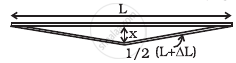
A rail track made of steel having length 10 m is clamped on a raillway line at its two ends (figure). On a summer day due to rise in temperature by 20° C, it is deformed as shown in figure. Find x (displacement of the centre) if αsteel = 1.2 × 10⁻⁵/°C.
Each side of a box made of metal sheet in cubic shape is 'a' at room temperature 'T', the coefficient of linear expansion of the metal sheet is 'α'. The metal sheet is heated uniformly, by a small temperature ΔT, so that its new temeprature is T + ΔT. Calculate the increase in the volume of the metal box.
The height of mercury column measured with brass scale at temperature T0 is H0. What height H' will the mercury column have at T = 0°C. Coefficient of volume expansion of mercury is γ. Coefficient of linear expansion of brass is α ______.
A glass flask is filled up to a mark with 50 cc of mercury at 18°C. If the flask and contents are heated to 38°C, how much mercury will be above the mark? (α for glass is 9 × 10⁻⁶/°C and coefficient of real expansion of mercury is 180 × 10-6/°C)
A metal rod Y = 2 × 10¹² dyne cm-2 of coefficient of linear expansion 1.6 × 10⁻⁵ per °C has its temperature raised by 20°C. The linear compressive stress to prevent the expansion of the rod is ______.
The increase in the dimensions of a body due to an increase in its temperature is called ______.
When a solid is heated, its atoms vibrate faster and move farther apart. This happens because ______.
Among solids, liquids, and gases, the thermal expansion on heating is ______.
The volume of a block of metal at 30°C changes by 0.12% when its temperature is increased to 70°C. The coefficient of linear expansion of the metal is ______.
