Advertisements
Advertisements
प्रश्न
The radius of a metal sphere at room temperature T is R, and the coefficient of linear expansion of the metal is α. The sphere is heated a little by a temperature ∆T so that its new temperature is T + ∆T. The increase in the volume of the sphere is approximately ______.
विकल्प
2πRα∆T
πR2α∆T
4πR3α∆T/3
4πR3α∆T
Advertisements
उत्तर
The radius of a metal sphere at room temperature T is R, and the coefficient of linear expansion of the metal is α. The sphere is heated a little by a temperature ∆T so that its new temperature is T + ∆T. The increase in the volume of the sphere is approximately `underline(4πR^3α∆T)`.
Explanation:
Let the radius of the sphere is R. As the temperature increases the radius of the sphere increases as shown.
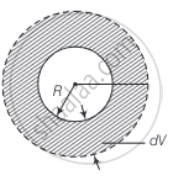
Original volume `V_0 = 4/3 piR^3`
Coefficient of linear expansion = α
∴ Coefficient of volume expansion = 3α
∴ `1/V (dV)/(dT)` = 3α
⇒ dV = 3Vαdt ≃ 4πR3α∆T
= Increase in the volume
APPEARS IN
संबंधित प्रश्न
A steel tape 1m long is correctly calibrated for a temperature of 27.0 °C. The length of a steel rod measured by this tape is found to be 63.0 cm on a hot day when the temperature is 45.0 °C. What is the actual length of the steel rod on that day? What is the length of the same steel rod on a day when the temperature is 27.0 °C? Coefficient of linear expansion of steel = 1.20 × 10⁻⁵ K–1
If two bodies are in thermal equilibrium in one frame, will they be in thermal equilibrium in all frames?
If mercury and glass had equal coefficients of volume expansion, could we make a mercury thermometer in a glass tube?
If an automobile engine is overheated, it is cooled by pouring water on it. It is advised that the water should be poured slowly with the engine running. Explain the reason.
A gas thermometer measures the temperature from the variation of pressure of a sample of gas. If the pressure measured at the melting point of lead is 2.20 times the pressure measured at the triple point of water, find the melting point of lead.
Answer the following question.
State applications of thermal expansion.
A glass flask has a volume 1 × 10⁻⁴ m3. It is filled with a liquid at 30°C. If the temperature of the system is raised to 100°C, how much of the liquid will overflow? (Coefficient of volume expansion of glass is 1.2 × 10⁻⁵ (°C)−1 while that of the liquid is 75 × 10−5 (°C)−1).
A hot body at a temperature 'T' is kept in a surrounding of temperature 'T0'. It takes time 't1' to cool from 'T' to 'T2', time t2 to cool from 'T2' to 'T3' and time 't3' to cool from 'T3' to 'T4'. If (T - T2) = (T2 - T3) = (T3 - T4), then ______.
A uniform metallic rod rotates about its perpendicular bisector with constant angular speed. If it is heated uniformly to raise its temperature slightly ______.
An aluminium sphere is dipped into water. Which of the following is true?
Find out the increase in moment of inertia I of a uniform rod (coefficient of linear expansion α) about its perpendicular bisector when its temperature is slightly increased by ∆T.
At what temperature a gold ring of diameter 6.230 cm be heated so that it can be fitted on a wooden bangle of diameter 6.241 cm? Both diameters have been measured at room temperature (27°C). (Given: coefficient of linear thermal expansion of gold αL = 1.4 × 10⁻⁵ K-1).
Each side of a box made of metal sheet in cubic shape is 'a' at room temperature 'T', the coefficient of linear expansion of the metal sheet is 'α'. The metal sheet is heated uniformly, by a small temperature ΔT, so that its new temeprature is T + ΔT. Calculate the increase in the volume of the metal box.
Length of steel rod so that it is 5 cm longer than the copper rod at all temperatures should be ______ cm.
(α for copper = 1.7 × 10⁻⁵/°C and α for steel = 1.1 × 10⁻⁵/°C)
Given below are two statements: one is labelled as Assertion A and the other is labelled as Reason R.
- Assertion A: When a rod lying freely is heated, no thermal stress is developed in it.
- Reason R: On heating, the length of the rod increases. In light of the above statements.
choose the correct answer from the options given below:
The increase in the dimensions of a body due to an increase in its temperature is called ______.
Which of the following correctly lists the three types of thermal expansion?
When a solid is heated, its atoms vibrate faster and move farther apart. This happens because ______.
