Advertisements
Advertisements
प्रश्न
The density of water at 0°C is 0.998 g cm–3 and at 4°C is 1.000 g cm–1. Calculate the average coefficient of volume expansion of water in the temperature range of 0 to 4°C.
Advertisements
उत्तर
Given:
Density of water at 0°C, ( f0)= 0.998 g cm-3
Density of water at 4°C, (f4) = 1.000 g cm-3
Change in temperature, (Δt) = 4oC
Let the average coefficient of volume expansion of water in the temperature range of 0 to 4°C be γ.
\[We know: f_4 = f_0 \left( 1 + \gamma ∆ t \right)\]
\[ \Rightarrow f_0 = \frac{f_4}{1 + \gamma ∆ t}\]
\[ \Rightarrow 0 . 998 = \frac{1}{1 + \gamma . 4}\]
\[ \Rightarrow 1 + 4\gamma = \frac{1}{0 . 998}\]
\[ \Rightarrow 4\gamma = \left( \frac{1}{0 . 998} \right) - 1\]
\[ \Rightarrow \gamma = 0 . 0005 = 5 \times {10}^{- 4} {}^o C^{- 1}\]
As the density decreases,
\[\gamma = - 5 \times {10}^{- 4} {}^o C^{-1}\]
Therefore,the average coefficient of volume expansion of water in the temperature range of 0 to 4°C will be
\[\gamma = - 5 \times {10}^{- 4}\]
APPEARS IN
संबंधित प्रश्न
If two bodies are in thermal equilibrium in one frame, will they be in thermal equilibrium in all frames?
A system X is neither in thermal equilibrium with Y nor with Z. The systems Y and Z
A gas thermometer measures the temperature from the variation of pressure of a sample of gas. If the pressure measured at the melting point of lead is 2.20 times the pressure measured at the triple point of water, find the melting point of lead.
Answer the following question.
What is thermal stress?
Solve the following problem.
A blacksmith fixes iron ring on the rim of the wooden wheel of a bullock cart. The diameter of the wooden rim and the iron ring are 1.5 m and 1.47 m respectively at room temperature of 27 °C. To what temperature the iron ring should be heated so that it can fit the rim of the wheel? (αiron = 1.2 × 10⁻⁵K–1).
A metal sphere 10.01 cm in diameter is placed on a brass ring of internal diameter 10 cm and at the same temperature of 12° C. The temperature up to which they should be heated together so that the metal sphere just passes through the ring is `[alpha_"metal"= 12 xx 10^-6//°"C" and alpha_"brass" =18 xx 10^-6//°"C"]` ____________.
A hot body at a temperature 'T' is kept in a surrounding of temperature 'T0'. It takes time 't1' to cool from 'T' to 'T2', time t2 to cool from 'T2' to 'T3' and time 't3' to cool from 'T3' to 'T4'. If (T - T2) = (T2 - T3) = (T3 - T4), then ______.
A bimetallic strip is made of aluminium and steel (αAl > αsteel) . On heating, the strip will ______.
A uniform metallic rod rotates about its perpendicular bisector with constant angular speed. If it is heated uniformly to raise its temperature slightly ______.
A student records the initial length l, change in temperature ∆T and change in length ∆l of a rod as follows:
| S.No. | l(m) | ∆T (C) | ∆l (m) |
| 1. | 2 | 10 | `4 xx 10^-4` |
| 2. | 1 | 10 | `4 xx 10^-4` |
| 3. | 2 | 20 | `2 xx 10^-4` |
| 4. | 3 | 10 | `6 xx 10^-4` |
If the first observation is correct, what can you say about observations 2, 3 and 4.
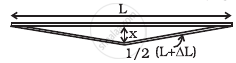
A rail track made of steel having length 10 m is clamped on a raillway line at its two ends (figure). On a summer day due to rise in temperature by 20° C, it is deformed as shown in figure. Find x (displacement of the centre) if αsteel = 1.2 × 10⁻⁵/°C.
At what temperature a gold ring of diameter 6.230 cm be heated so that it can be fitted on a wooden bangle of diameter 6.241 cm? Both diameters have been measured at room temperature (27°C). (Given: coefficient of linear thermal expansion of gold αL = 1.4 × 10⁻⁵ K-1).
If the length of a cylinder on heating increases by 2%, the area of its base will increase by ______.
A disc is rotating freely about its axis. The percentage change in angular velocity of a disc if temperature decreases by 20°C is ______.
(coefficient of linear expansion of material of disc is 5 × 10⁻⁴/°C)
If the temperature of the sun were to increase from T to 2T and its radius from R to 2R, then the ratio of the radiant energy received on earth to what it was previously will be ______.
A clock with an iron pendulum keeps the correct time at 15°C. If the room temperature is 20°C, the error in seconds per day will be near ______.
(coefficient of linear expansion of iron is 1.2 × 10⁻⁵/°C)
When heat is given to a substance, it generally ______.
When a solid is heated, its atoms vibrate faster and move farther apart. This happens because ______.
