Advertisements
Advertisements
प्रश्न
Answer the following question.
Derive the relation between three coefficients of thermal expansion.
Advertisements
उत्तर
- Consider a square plate of side l0 at 0° C and lT at T °C.
∴ lT = l0 (1 + αT)
If area of plate at 0° C is A0, A0 = `l_0^2`
If area of plate at T °C is AT,
`"A"_"T" = l_1^2 = l_0^2 (1 +alpha"T")^2`
or `"A"_"T" = "A"_0(1 + alpha"T")^2` ....(1)
Also,
`"A"_"T" = "A"_0(1 + beta"T")` ....(2) `[because beta = ("A"_"r" - "A"_0)/("A"_0("T" - "T"_0))]` - Using Equations (1) and (2),
`"A"_0(1 + alpha"T")^2 = "A"_0(1 + beta"T")`
∴ `1 + 2alpha"T" + alpha^2"T"^2 = 1 + beta"T"` - Since the values of α are very small, the term α2T2 is very small and may be neglected.
∴ β = 2α - The result is general because any solid can be regarded as a collection of small squares.
- Consider a cube of side l0 at 0 °C and lT at T °C.
∴ lT = l0(1 + αT)
If volume of the cube at 0 °C is V0, V0 = `l_0^3`
If volume of the cube at T °C is
`"V"_"T", "V"_"T" = l_"T"^3 = l_0^3 (1 + alpha"T")^3`
`"V"_"T" = "V"_0(1 + alpha"T")^3` ....(1)
Also,
`"V"_"T" = "V"_0(1 + gamma"T")` ....(2) ...`[therefore gamma = ("V"_"T" - "V"_0)/("V"_0("T" - "T"_0))]` - Using Equations (1) and (2),
`"V"_0 (1 + alpha"T")^3 = "V"_0(1 + gamma"T")`
∴ `1 + 3alpha"T" + 3alpha^2"T"^2 + alpha^3"T"^3 = 1 + gamma"T"` - Since the values of α are very small, the terms with higher powers of α may be neglected.
∴ γ = 3α - The result is general because any solid can be regarded as a collection of small cubes.
- Relation between α, β and γ is given by,
`alpha = beta/2 = gamma/3`
where, α = coefficient of linear expansion,
β = coefficient of superficial expansion,
γ = coefficient of cubical expansion.
APPEARS IN
संबंधित प्रश्न
A hole is drilled in a copper sheet. The diameter of the hole is 4.24 cm at 27.0 °C. What is the change in the diameter of the hole when the sheet is heated to 227 °C? Coefficient of linear expansion of copper = 1.70 × 10⁻⁵ K–1.
A brass rod of length 50 cm and diameter 3.0 mm is joined to a steel rod of the same length and diameter. What is the change in length of the combined rod at 250 °C, if the original lengths are at 40.0 °C? Is there a ‘thermal stress’ developed at the junction? The ends of the rod are free to expand (Co-efficient of linear expansion of brass = 2.0 × 10⁻⁵ K–1, steel = 1.2 × 10⁻⁵ K–1).
The coefficient of volume expansion of glycerin is 49 × 10–5 K–1. What is the fractional change in its density for a 30 °C rise in temperature?
For a constant-volume gas thermometer, one should fill the gas at
The density of water at 0°C is 0.998 g cm–3 and at 4°C is 1.000 g cm–1. Calculate the average coefficient of volume expansion of water in the temperature range of 0 to 4°C.
Show that the moment of inertia of a solid body of any shape changes with temperature as I = I0 (1 + 2αθ), where I0 is the moment of inertia at 0°C and α is the coefficient of linear expansion of the solid.
Answer the following question.
State applications of thermal expansion.
Answer the following question.
Give an example of the disadvantages of thermal stress in practical use?
Solve the following problem.
A blacksmith fixes iron ring on the rim of the wooden wheel of a bullock cart. The diameter of the wooden rim and the iron ring are 1.5 m and 1.47 m respectively at room temperature of 27 °C. To what temperature the iron ring should be heated so that it can fit the rim of the wheel? (αiron = 1.2 × 10⁻⁵K–1).
A metre scale made of a metal reads accurately at 25 °C. Suppose in an experiment an accuracy of 0.12 mm in 1 m is required, the range of temperature in which the experiment can be performed with this metre scale is ______.(coefficient of linear expansion of the metal is `20 xx 10^-6 / (°"C")`
A metal rod is heated to t°C. A metal rod has length, area of cross-section, Young's modulus and coefficient of linear expansion as 'L', 'A', 'Y' and 'a' respectively. When the rod is heated, the work performed is ______.
A metal rod of Young's moduls 'Y' and coefficient of linear expansion 'a' has its temeprature raised by 'Δ θ'. The linear stress to prevent the expansion of rod is ______.
(L and l is original length of rod and expansion respectively)
The volume of a metal block changes by 0.86% when heated through 200 °C then its coefficient of cubical expansion is ______.
Calculate the stress developed inside a tooth cavity filled with copper when hot tea at temperature of 57°C is drunk. You can take body (tooth) temperature to be 37°C and α = 1.7 × 10⁻⁵/°C, bulk modulus for copper = 140 × 109 N/m2.
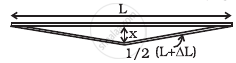
A rail track made of steel having length 10 m is clamped on a raillway line at its two ends (figure). On a summer day due to rise in temperature by 20° C, it is deformed as shown in figure. Find x (displacement of the centre) if αsteel = 1.2 × 10⁻⁵/°C.
At what temperature a gold ring of diameter 6.230 cm be heated so that it can be fitted on a wooden bangle of diameter 6.241 cm? Both diameters have been measured at room temperature (27°C). (Given: coefficient of linear thermal expansion of gold αL = 1.4 × 10⁻⁵ K-1).
If the length of a cylinder on heating increases by 2%, the area of its base will increase by ______.
An anisotropic material has coefficient of linear thermal expansion α1, α2 and α3 along x, y and z-axis respectively. Coefficient of cubical expansion of its material will be equal to ______.
A disc is rotating freely about its axis. The percentage change in angular velocity of a disc if temperature decreases by 20°C is ______.
(coefficient of linear expansion of material of disc is 5 × 10⁻⁴/°C)
Given below are two statements: one is labelled as Assertion A and the other is labelled as Reason R.
- Assertion A: When a rod lying freely is heated, no thermal stress is developed in it.
- Reason R: On heating, the length of the rod increases. In light of the above statements.
choose the correct answer from the options given below:
A glass flask is filled up to a mark with 50 cc of mercury at 18°C. If the flask and contents are heated to 38°C, how much mercury will be above the mark? (α for glass is 9 × 10⁻⁶/°C and coefficient of real expansion of mercury is 180 × 10-6/°C)
A clock with an iron pendulum keeps the correct time at 15°C. If the room temperature is 20°C, the error in seconds per day will be near ______.
(coefficient of linear expansion of iron is 1.2 × 10⁻⁵/°C)
The increase in the dimensions of a body due to an increase in its temperature is called ______.
When a solid is heated, its atoms vibrate faster and move farther apart. This happens because ______.
Among solids, liquids, and gases, the thermal expansion on heating is ______.
A metallic bar of Young’s modulus, 0.5 × 10¹¹ N m−2 and coefficient of linear thermal expansion 10−5°C−1, length 1 m and area of cross-section 10−3 m2 is heated from 0°C to 100°C without expansion of bending. The compressive force developed in it is ______.
The volume of a block of metal at 30°C changes by 0.12% when its temperature is increased to 70°C. The coefficient of linear expansion of the metal is ______.
